Zhuque in Chinese Mythology: The Vermilion Bird of the South
Zhuque in Chinese mythology is more precise than “the Chinese phoenix.” Zhuque, the Vermilion Bird, is the southern member of the Four Symbols: a guardian of a sky sector, a seasonal and elemental sign, and an image found in Han tomb art and later ritual traditions. Its red color and bird shape make the phoenix comparison tempting, but the two figures do not begin with the same job.
Zhuque in Chinese Mythology: The Southern Quarter
Start with the Four Symbols. Qinglong, the Azure Dragon, holds the east; Zhuque the south; Baihu, the White Tiger, the west; and Xuanwu, the Dark Warrior or Black Tortoise, the north. Each figure is a direction and a slice of sky before later stories hand the animals personalities of their own.
Ellen Van Goethem's peer-reviewed chapter on the four directional animals notes that China, Korea and Japan all place the Vermilion Bird (朱雀) at the front/south, with the Azure Dragon left/east, the White Tiger right/west and the Black Turtle-Snake back/north. She also warns that the earliest divination texts stay vague about which landscape features stand for each animal, and that at least two traditions grew up later. So one neat modern diagram isn't the whole ancient picture.
The south position gives Zhuque a spatial job. It can mark a gate, a wall, a burial chamber or a quarter of a ritual diagram. When a novel puts a Vermilion Bird on the southern gate of a sect, the name is doing architectural work before anyone casts a flame technique.
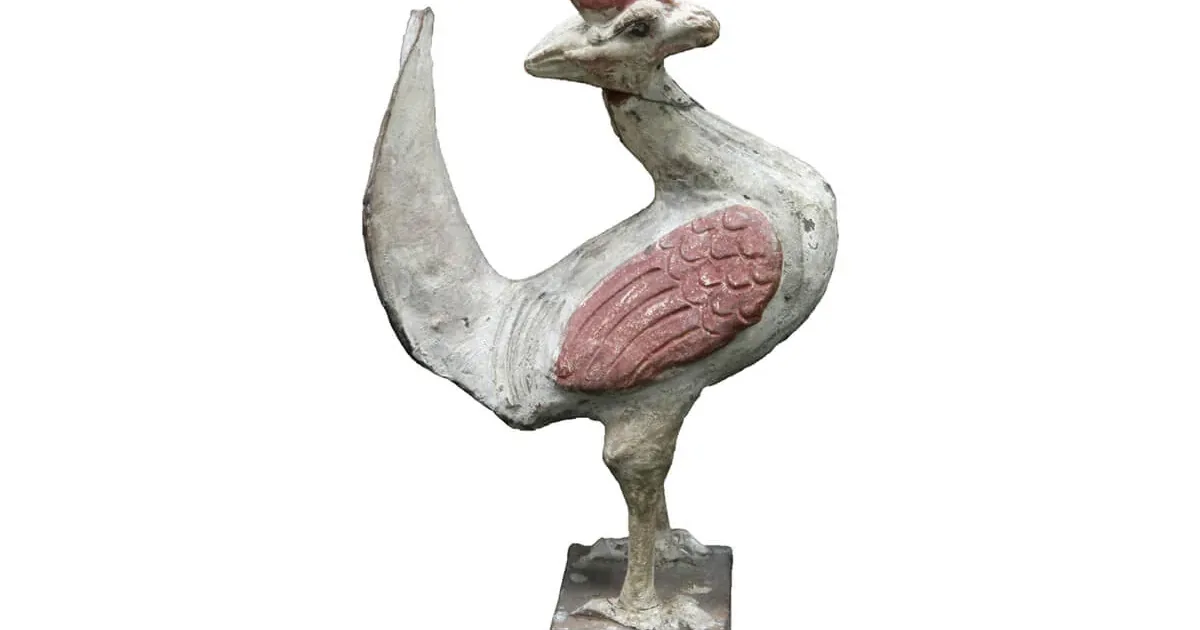 Image: National Museum of Natural Science, Taichung, collection object NMNS000827
Read Qinglong in Chinese mythology for the eastern counterpart. The east/spring/wood pattern makes Zhuque's south/summer/fire position easier to see as part of a system.
Zhuque's Stars: Seven Southern Lunar Mansions
The star layer comes first. The Hong Kong Space Museum's glossary of Chinese star regions says that "Seven Mansions form one Symbol," and lists the Vermilion Bird's seven: Well, Ghosts, Willow, Star, Extended Net, Wings and Chariot (井, 鬼, 柳, 星, 張, 翼, 軫). English names for single mansions vary from book to book; the grouping doesn't.
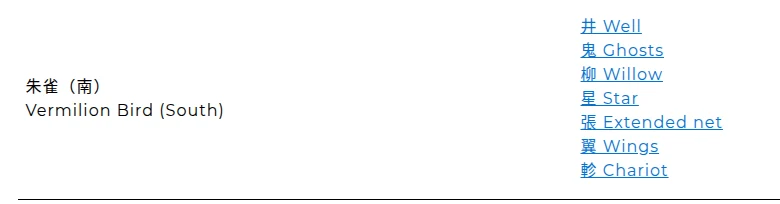 Screenshot: Hong Kong Space Museum, English-Chinese Glossary of Chinese Star Regions, Asterisms and Star Names
The same glossary calls the twenty-eight mansions "the regions near the ecliptic and the lunar path, where the Sun, the Moon and the planets pass by." The bird's "south" is a direction on the ground and a band of the night sky at once. A writer who drops Zhuque into a star map, an astrology system or a formation is drawing on that oldest layer.
The Henan Museum's essay on a Han four-spirits pot puts it plainly: "The four spirits emerged in the process of astronomical observation by the ancient people." That doesn't make every red bird a full Zhuque. It does explain why the bird reads as a sign of cosmic order rather than a free-floating fire mascot.
Summer, Fire, and Yang
The south brings a season and a phase. The Henan essay gives each beast a season and ends the list with "the Vermilion Bird of summer." The National Museum of Natural Science in Taichung, in its record for a Han pottery Vermilion Bird, quotes the Lunheng: "the south is fire and its star is the vermilion bird," and adds that the bird "belongs to fire and like the phoenix symbolizes yang."
That's where xianxia's red flames and summer brightness come from, and it's also their limit: fire belongs to a chart of correspondences, not to a personality. In a ritual setting it can mean light, vitality or the yang side of a balance. In a tomb, a bright bird can guard the soul. In a novel, it can be a technique that burns, a guardian that lights a path, or a body moving from earth toward the sky.
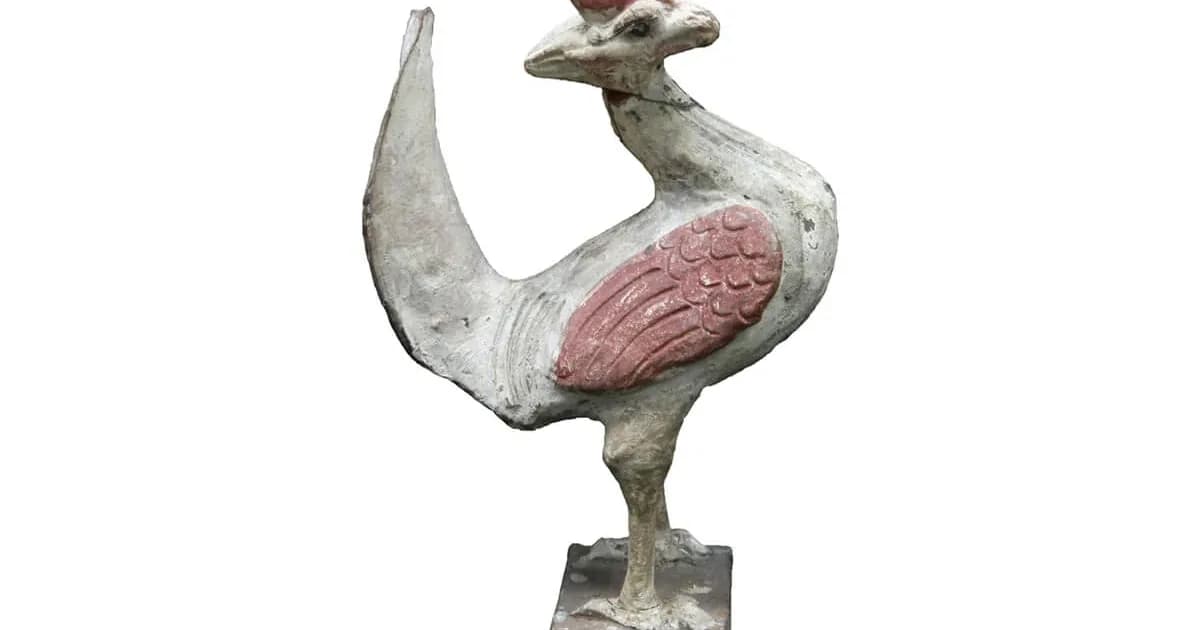
"Vermilion" needs care too. The museum's figure isn't red from head to tail: its body is white, with red glaze on the wings and crest and black lines around the eyes. The name is a symbolic category, not a paint chart.
The Museum Record: A Han Bird With a Tomb Context
The Taichung museum catalogues the figure as NMNS000827: hollow, gray-bodied, glazed white, red and black, and just 20.8 centimeters wide and 14.2 tall. It was identified as Han when it entered the collection. It's shaped like a pheasant with its chest and tail raised, holds a white bead in its beak and stands on a thin plate base.
The record says the Vermilion Bird turns up in Warring States and Han references, guards the south with the black tortoise, azure dragon and white tiger, and "often appeared on tomb portrait bricks" from the Han on. It's honest about the gap, too: "It is impossible to trace whether this pottery figure of a vermilion bird appeared together with the other three types of mythical creatures." So this bird can't prove that every tomb set out all four.
The curators' reading is still the best part of the page. Because of its yang nature, they write, the figure "was most likely placed in the tomb to protect the soul of the deceased," and the bird stands for communication between humans and the heavens and "the desire to reach the heavens and become immortal." That's a reading of one object, not a rule for every Vermilion Bird image.
The bead in its beak has its own story. The record ties it to tales in the Taiping Yulan and Shi Yi Ji in which a phoenix arrives at the palace of Shaohao, the Yellow Emperor's son, holding a pearl that he makes "shine on the world." Even this guardian of the south borrows a phoenix legend, which is a good sign of how tangled the two birds are.
Zhuque and Fenghuang Are Not Synonyms
It's tempting to translate Zhuque as "phoenix" and stop there. Don't. Fenghuang is a separate bird tradition with its own stories and symbolism. Zhuque belongs to the Four Symbols and the southern quarter of the sky. The two share red, yang, good omens and the sun, which explains centuries of overlap, but overlap isn't identity. The Taichung record draws a simple line: "the phoenix is mostly colorful, while the vermilion bird is mostly vermilion."
Marianna Lázár's 2026 study of Han tomb art, Animating the Cosmos, shows how old the muddle is. In classical sources, she writes, the name Zhuque is "sometimes used interchangeably" with, or even confused with, other "solar-associated figures": Zhuniao, Fenghuang and Sanzuwu, the three-legged crow, among them. She also finds that the Vermilion Bird's look "remained somewhat in flux throughout the Han dynasty," with "no standardized form" for the bird.
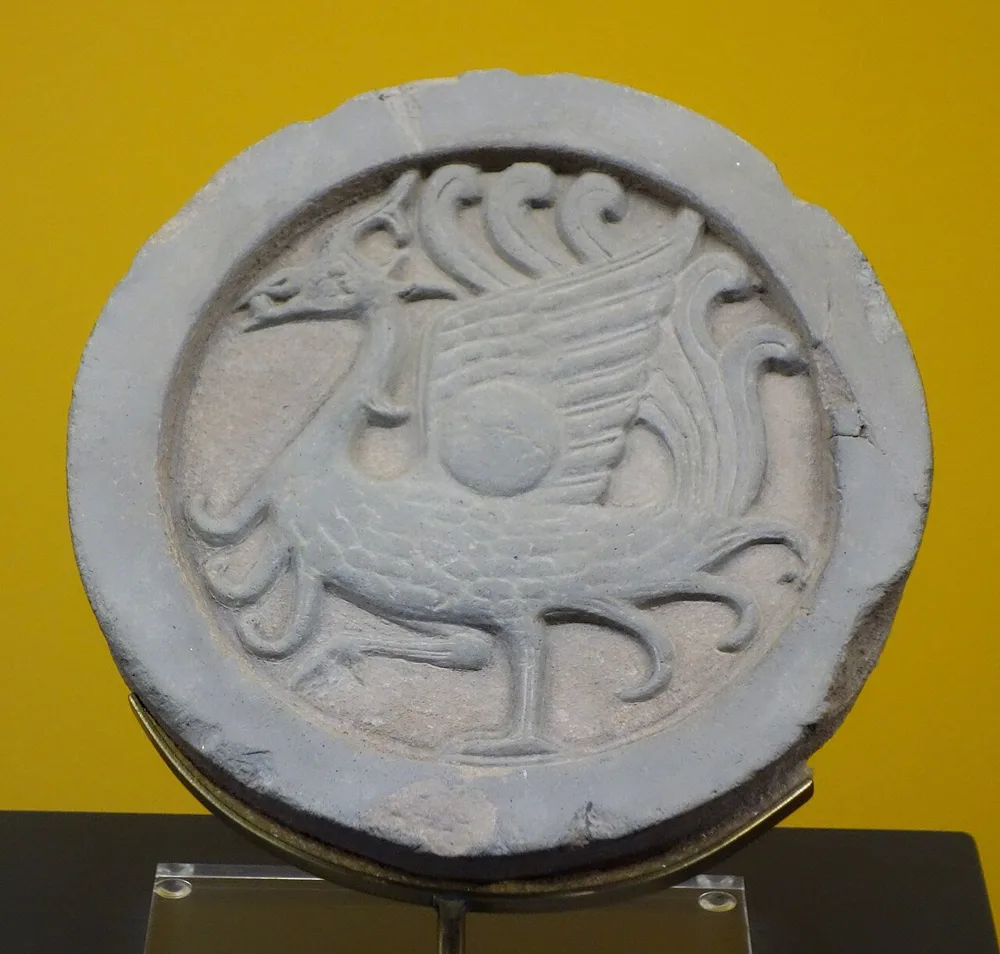 Image: Wikimedia Commons, Daderot, CC0. Roof tile fragment with vermilion bird, Western Han, Royal Ontario Museum
Readers still merge them. Asked in r/mythology "Is the Phoenix stronger than the Vermillion bird," a very xianxia question, one reply answered that "the fenghuang is the same as the vermillion bird." That's exactly the shortcut the museum and Lázár warn against. The objects keep the bird in its set instead. A bronze mirror that u/kautaiuang posted to r/taoism as Han-era carries the line "左龍右虎辟不祥,朱鳥玄武調陰陽," roughly "dragon on the left and tiger on the right ward off misfortune, Vermilion Bird and Dark Warrior balance yin and yang" (our translation). The bird on it is 朱鳥, Zhuniao, the alternate name Lázár lists. A reply in the same thread adds a fair caution about labels: "Daoists drew on many already-existing ideas."
Our practical test: look at the company the bird keeps. Does it appear with the dragon, tiger and tortoise? Does it hold the south or a group of seven stars? Does the text tie it to summer or fire in a four-direction chart? Then it's Zhuque. A lone bird of good omen with none of that around it is more likely a fenghuang.
Zhuque in Chinese Mythology and Xianxia Fiction
Xianxia writers use Zhuque in Chinese mythology as a compact promise of heat, visibility and movement toward the sky. A Vermilion Bird bloodline can burn through a frozen meridian. A southern formation can post the bird as gate guardian. A sect's summer rite can borrow the color, season and yang without claiming its hero is literally a star map.
The adaptations we like best keep one relationship visible: a fire technique that burns brightest at noon, a guardian that faces the southern gate, a character who trades a mortal body for a bird-shaped ascent. A loose adaptation can still be fun, but you should be able to tell whether the story is citing Zhuque or just picking a dramatic red bird.
The same test works across genres. What is xianxia? covers the cultivation vocabulary that surrounds spirit beasts. What is xuanhuan? helps when a novel drops Zhuque into a broader fantasy world. For the rest of the set, compare Baihu in Chinese mythology, Xuanwu in Chinese mythology and the eastern explainer for Qinglong.
Read Kunpeng in Chinese mythology for a different kind of transformation. Kunpeng moves from fish to bird; Zhuque stays within the southern guardian system while fiction decides how much metamorphosis to add.
Zhuque Is Not Every Phoenix or Firebird
Zhuque isn't the zodiac rooster, every "phoenix" in an English translation, or a universal symbol of rebirth. Modern games and novels may give it resurrection, immortality or a fire-reborn body. Those are creative extensions, not definitions that replace its Four Symbols context.
It isn't one fixed picture, either. The pottery pheasant and the roof-tile bird above look nothing alike, which is Lázár's point about a bird with no standard form. What carries over is the bird's place in the directional and astral system, not a silhouette.
And "Vermilion Bird" doesn't mean always kind or always hostile. As with the other guardians, a scene can lean on protection, judgment, communication or danger. Let the story tell you which layer is active.
Our Take
Read Zhuque as an address first: south, summer, fire, seven mansions. When a novel uses any of those, the name is earning its place. When a book calls a resurrecting firebird "Vermilion Bird," it's really writing a phoenix with a Chinese label, which is fine for a fight scene and wrong in a glossary. If you're working through the set, Qinglong, Baihu and Xuanwu below follow the same pattern from the other three directions.
Related Reading
- Qinglong in Chinese Mythology: The Azure Dragon of the East
- Baihu in Chinese Mythology: The White Tiger of the West
- Xuanwu in Chinese Mythology: Star Chart to Living God
- Kunpeng in Chinese Mythology
- Taowu in Chinese Mythology
- What Is Xianxia? A Beginner's Guide
References
- National Museum of Natural Science: Pottery Figure of Vermilion Bird
- Henan Museum: Covered Painted Pottery Pot with Four Spirits Pattern
- Hong Kong Space Museum: English-Chinese Glossary of Chinese Star Regions
- Kyushu University: The Four Directional Animals in East Asia
- Marianna Lázár, Animating the Cosmos
- Wikimedia Commons: Roof tile fragment with vermilion bird, Royal Ontario Museum
- r/mythology: Phoenix/Fenghuang vs Vermillion bird/Zhuque
- r/taoism: A Han dynasty Shangfang four symbols bronze mirror

About the author

Danmei & Genre Explainers Desk
Pen name for NovelBrief's danmei and genre desk: xianxia and xuanhuan conventions, danmei licensing, what a print edition changes.
- Covers danmei, xianxia and xuanhuan, plus genre explainers
- Separates publisher-confirmed facts from fan speculation
- Flags content ratings when the source states them
Keep reading
Qinglong in Chinese Mythology: The Azure Dragon of the East
Novels · 9 min
Baihu in Chinese Mythology: The White Tiger of the West
Novels · 7 min
Xuanwu in Chinese Mythology: The Black Tortoise, Then a God
Novels · 9 min
Shan Hai Jing: Classic of Mountains and Seas Explained
Novels · 7 min
Taowu in Chinese Mythology: A Four Perils Beast, Once a Man
Novels · 8 min
Kunpeng: The Myth Behind Xianxia's Giant Sky Beasts
Novels · 6 min

Qilin in Chinese Mythology: Why Xianxia Turned It Into a Pet
Novels · 7 min
Hundun in Chinese Mythology: The Faceless God of Chaos
Novels · 7 min
Disclaimer
This article is published for informational and entertainment purposes. It does not constitute professional financial, legal, or technical advice. Series availability, platform access, translation status, and chapter counts change. Verify critical details (pricing, regional availability, official translation status) with publishers and platforms. Affiliate links, where present, help support our editorial work and are labelled in our affiliate disclosure.