Loading…

NovelBrief · Novels
Kunpeng: The Myth Behind Xianxia's Giant Sky Beasts
Kunpeng begins as Zhuangzi's transforming fish and bird. Learn what the image means and why xianxia fiction keeps returning to its scale.
6 min readBy Mei-Lin Zhao
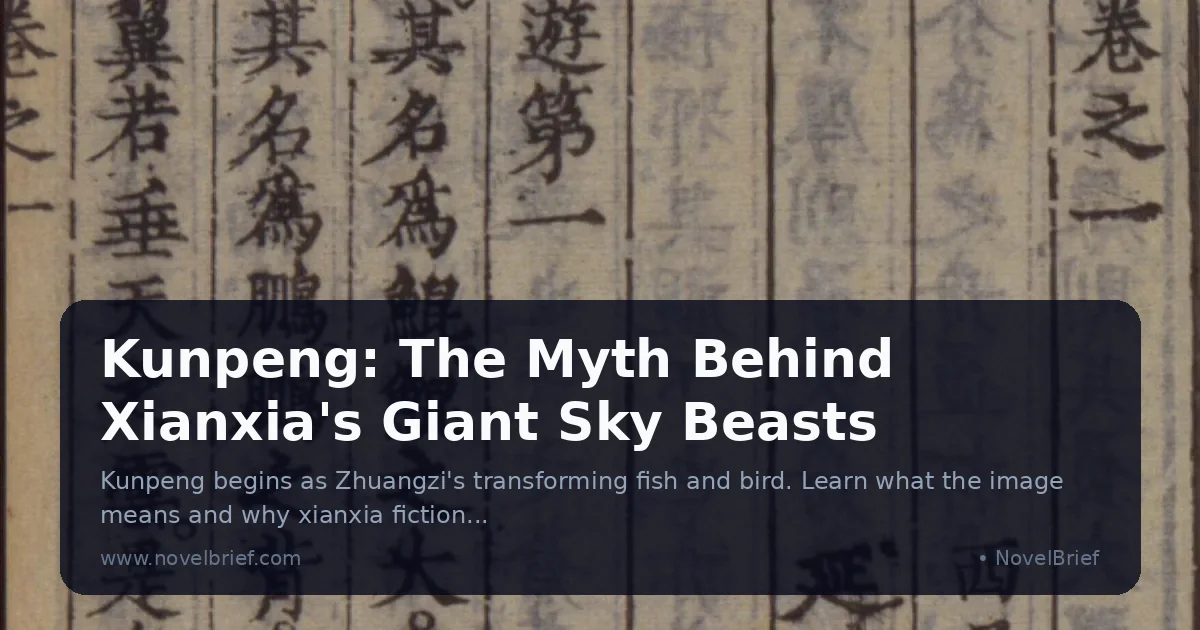
Kunpeng is often reduced to a giant bird-shaped upgrade in fantasy fiction. That misses the strange sequence that made the image last. In Zhuangzi's opening chapter, Kun is a fish of unknowable size in the northern darkness; it transforms into Peng, whose wings are compared to clouds and whose flight requires enormous wind.
TL;DR: Kunpeng is not simply a Chinese phoenix or a fixed fish-bird species. It is the Kun-to-Peng transformation that opens Zhuangzi, where scale, wind, depth, and limited perspective matter as much as the creature itself.
Key Takeaways
- The received Zhuangzi begins with Kun, a giant fish, changing into Peng, an immense bird.
- Kunpeng is a modern joined label for that sequence. The text gives two names and a transformation.
- The chapter places the flight beside smaller creatures and questions of what each can understand from its own position.
- Xianxia and xuanhuan borrow the image because it instantly signals vast travel, metamorphosis, and a scale beyond ordinary beasts.
- Calling Peng a phoenix or a generic roc imports associations that the Zhuangzi passage does not supply.
Kunpeng in Zhuangzi: A Transformation, Not a Bestiary Entry
The most useful place to start with Kunpeng is the first lines of Xiaoyaoyou ("Free and Easy Wandering"). Stanford's Chinese Texts edition preserves the chapter within the received Zhuangzi. A scholarly study of the text notes that Kun and Peng are among the imaginary animals used in its fables, while later commentaries frame the passage around freedom, nature, and perspective.
The distinction in the wording matters. Kun is the fish. Peng is the bird after change. Modern Chinese and English usage often runs the two together as Kunpeng, which is convenient but can make readers picture a permanent chimera. The old story does not pause to provide one. It moves from a depth that can hold the fish, to the wind that can carry the bird, to the tiny creatures who cannot see why such a journey is needed.
That is why the huge numbers in translations should not be treated like a zoological stat block. The passage uses excess to rearrange perspective. The quail and cicada cannot imagine Peng's destination because their own short flights already solve their needs. Peng is not simply stronger. It occupies a different range of possibility.
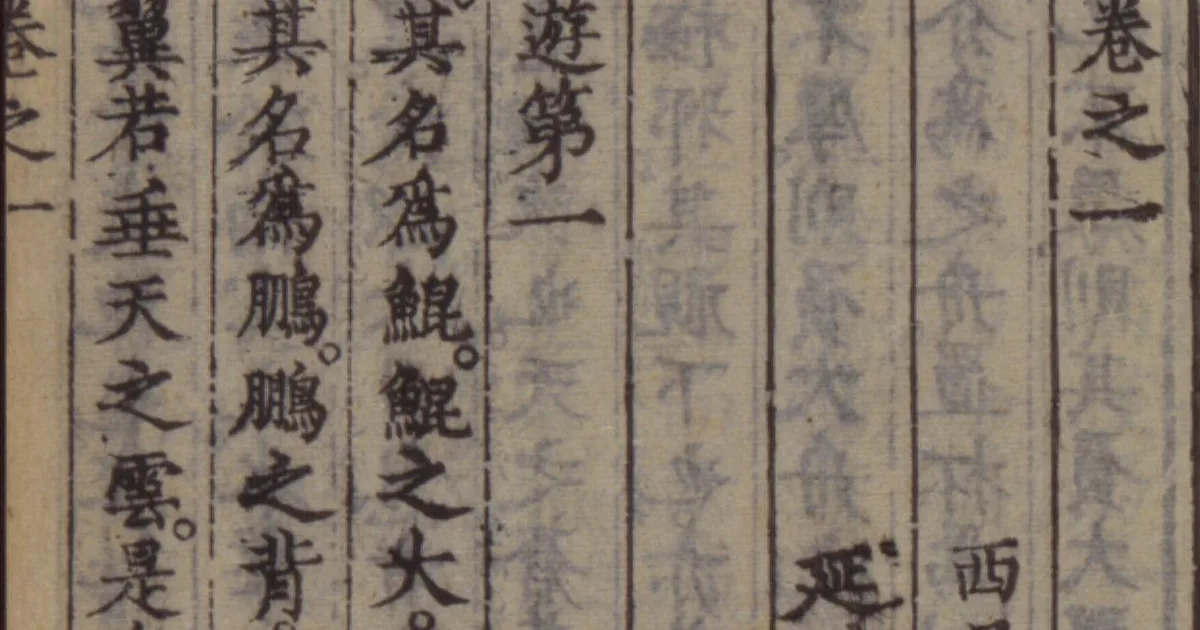 Caption: A National Central Library digital-archive page from a Ming edition of Zhuangzi's Inner Chapters, including the Xiaoyaoyou passage associated with Kun and Peng.
The creature makes more sense once the genre's cultivation language is clear.
What Is Xianxia? A Beginner's Guide to Cultivation Novels →
What Kunpeng Is Not
Kunpeng is not the fenghuang. The latter is a separate Chinese bird image with its own history, iconography, and later symbolic uses. Translating Peng as "phoenix" may make a sentence feel familiar to English readers, but it collapses a distinction the source does not make.
It is not neatly identical to the roc either. "Roc" can communicate bigness, yet it brings Arabic and European literary baggage. Leaving Kun and Peng untranslated is often clearer when the point is the movement between forms. The Zhuangzi is not building a shared fantasy ecology. It is telling a story whose comparisons ask how depth supports a boat and how accumulated wind supports a flight.
The image also resists a single moral label. A 2012 study of Kun-Peng traditions identifies several fish-bird transformation and coexistence patterns across later myth material. That does not mean every later bird is secretly Kunpeng. It does show why a simple "freedom symbol" label is too thin for an image with a long interpretive afterlife.
How Xianxia and Xuanhuan Reuse Kunpeng
Modern web fiction rarely needs to reintroduce the full philosophical argument. Kunpeng works as compressed cultural shorthand. A bird-shaped mount, a bloodline, a movement art, or a named technique can imply distance that ordinary flying swords cannot cover. A beast that begins in water and takes the sky can also make transformation itself feel like an elevation of realm.
That borrowing changes the emphasis. In a cultivation serial, a Kunpeng title often promises speed, scale, or a breakthrough. In Xiaoyaoyou, the flight is also a test of comparative viewpoint. Smaller birds laugh because they do not share the conditions that make Peng's journey possible. This gives an attentive writer more than a flashy name: it gives an image for the difference between local ambition and a horizon large enough to make local measures fail.
There is a limit to the reuse. Not every enormous bird in a xianxia novel is a citation, and no reader should infer a character's rank from the name alone. The more useful distinction is whether the story invokes the full transition from Kun to Peng, or only borrows Peng as a prestigious label. The first preserves change and altered perspective. The second is mostly decorative grandeur.
For the boundary between myth-rooted xianxia and broader fantasy, see
What Is Xuanhuan? The Chinese Fantasy Genre Explained →
Reading Kunpeng Without Flattening It
When Kunpeng appears in a novel, ask four questions. Is it a beast, a lineage, a technique, or a metaphor? Does the scene include water, wind, distance, or transformation? Who is being asked to see beyond a smaller frame? And does the writer let the name alter the plot, or merely attach it to an oversized attack?
Those questions keep the source and the adaptation connected without pretending a web novel must reproduce Daoist philosophy. An author can use Kunpeng for spectacle and still use it well. The image becomes richer when the flight changes what the protagonist can perceive, not only how hard the protagonist can hit.
For readers tracking this vocabulary across genres, our xianxia beginner's guide covers the cultivation terms that usually surround it, while wuxia versus xianxia explains why the same animal image can feel different in a martial-arts story.
Frequently Asked Questions
Q: Is Kunpeng a fish or a bird? In the Zhuangzi sequence, it is both at different moments: Kun is the fish and Peng is the transformed bird.
Q: Where does the story occur? It opens Xiaoyaoyou, the first Inner Chapter of the received Zhuangzi.
Q: Why is wind important? The passage makes the bird's great flight depend on accumulated wind, matching its interest in the conditions that make different kinds of movement possible.
Q: Is Kunpeng always a divine beast in web novels? No. Authors use the name for creatures, inherited bloodlines, arts, ships, and imagery. The specific role is a local choice.
Q: Should Peng be translated as phoenix? Usually no. It risks merging Peng with fenghuang, a distinct Chinese bird tradition.
Related Reading
- What Is Xianxia? A Beginner's Guide to Cultivation Novels
- What Is Xuanhuan? The Chinese Fantasy Genre Explained
- Wuxia vs Xianxia Novels: What's the Real Difference?
- Taowu in Chinese Mythology: Monster and Book Title Both
- Xuanwu in Chinese Mythology: Star Chart to Living God
References
About the author

Danmei & Genre Critic
Danmei and xianxia critic with a background in comparative literature, writing about Chinese web fiction in English since 2019. Toronto-based.
- Writing about danmei and xianxia in English since 2019
- Graduate background in comparative literature
- Tracks the fan-translation-to-official-license pipeline
- Follows Seven Seas' convention announcements directly



Disclaimer
This article is published for informational and entertainment purposes. It does not constitute professional financial, legal, or technical advice. Series availability, platform access, translation status, and chapter counts change. Verify critical details (pricing, regional availability, official translation status) with publishers and platforms. Affiliate links, where present, help support our editorial work and are labelled in our affiliate disclosure.
Comments
Loading comments…