
Qilin in Chinese Mythology: Why Xianxia Turned It Into a Pet
The classics' gentlest beast shows up for sages. Cultivation novels mostly want its blood.
Verdict: A qilin is a benevolent, hoofed, usually one-horned omen that appears for sages and good rulers. Web novels mostly use it as a bloodline or a pet; the ones worth reading keep it rare.
The big scene for the qilin in Chinese mythology is a hunting accident. In the spring of 481 BCE a charioteer on a hunt in the state of Lu caught one, decided it was bad luck and handed it to the forester; only when Confucius looked at it did anyone say, "It's a lin." That's the creature in one scene: a gentle omen of sages that the world doesn't deserve and doesn't recognize.

Cultivation novels have done something much less reverent with it. On Webnovel the qilin is a bloodline, a pet to upgrade and a title for a noble heir. We think that's fine, mostly. But the stories that remember what a qilin is for (rare, kind, a sign that someone worthy has arrived) get more out of it than the ones that hand it to the protagonist as a starter pet.
What a qilin looks like
The name is 麒麟 (qílín). The Han-era dictionary Shuowen Jiezi splits it: qi is the male, lin the female, and the qi is "a humane beast" with "elaphure's body, ox's tail, and one horn," as Wikipedia's translation puts it. The single word lin (麟) means the same creature, which is why the classics often use it alone.
Later art made it grander. Qilin are usually drawn with a dragon-like head, antlers, an upward-flowing mane, a beard, a body fully or partly covered in scales, and always cloven hooves. Some have one horn, some two, and some are shown with parts of the body on fire.
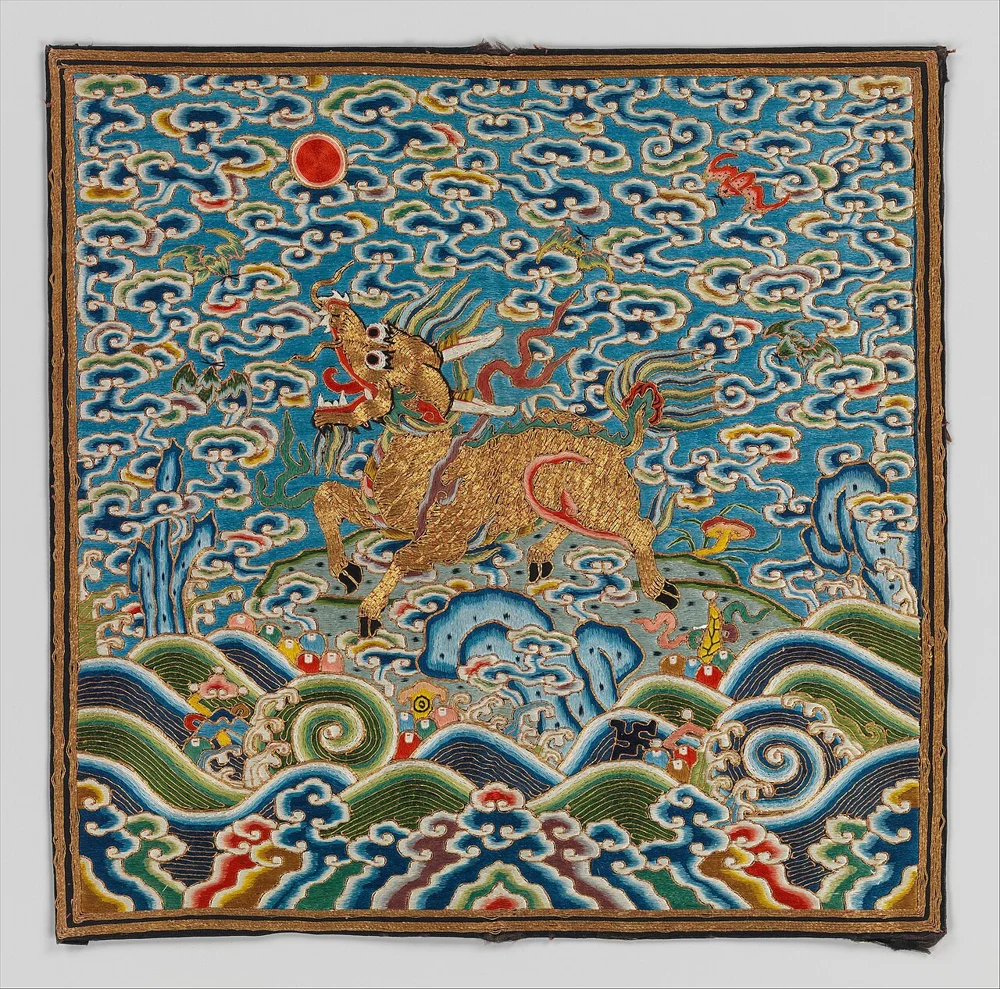 Image: Embroidered qilin buzi, Qing dynasty, Metropolitan Museum of Art, CC0, via Wikimedia Commons
That's why "Chinese unicorn" is both the accepted translation and a slightly misleading one. On r/noveltranslations, u/deathbladesjz explained why translators don't swap in a Western beast: "Chimera is not an accepted translation for qilin, although 'Chinese unicorn' is." u/zerodotjander gave the other half: "unicorn" would give "such an incorrect mental image to Westerners that people just choose not to translate it." We agree with leaving it as qilin. A unicorn is a horse with a horn; a qilin is closer to a dragon that grazes.
Qilin in Chinese mythology: first of the Four Spirits
The Book of Rites (Liji) gives the qilin top billing. Its "Liyun" chapter asks what the Four Spirits are and answers: 麟、鳳、龜、龍,謂之四靈, "the lin, the phoenix, the tortoise and the dragon." The same passage gives each one a job. With the lin among a ruler's creatures, it says, the other beasts don't bolt in panic (麟以爲畜,故獸不狘). Think of it as the animal that keeps the animal kingdom calm.
Notice what's missing: there's no tiger. If you came here from our page on Baihu, the White Tiger or Xuanwu, the Four Spirits are a different set from the Four Symbols, the guardians of the four directions (turtle-snake, dragon, bird and tiger), even though a dragon and a tortoise figure in both.
The earliest qilin on record is older still. The Classic of Poetry has a short song, "The Feet of the Lin" (麟之趾), praising a lord's sons by comparing them to the lin's feet, forehead and horn. The legends that grew from there all point the same way: qilin appear in the garden of the Yellow Emperor and the capital of Emperor Yao as proof that the ruler is good, and one is said to have announced the birth of Confucius.
The lin nobody recognized
Which brings us back to the hunt. The Spring and Autumn Annals give it one line, 西狩獲麟, "in the west, on the hunt, a lin was caught," in the fourteenth year of Duke Ai of Lu (481 BCE). The Zuo Zhuan commentary adds the details we read in the Chinese text on Wikisource: the Shusun family's charioteer, Chu Shang, caught it at Daye, "thought it inauspicious" (以為不祥) and gave it to the forester. Confucius looked at it and said, 麟也, "it's a lin." Only then did they take it back.
We read that as the most honest qilin story in the canon. The beast that's meant to arrive for a sage gets hauled off by a hunting party and needs a sage to name it at all. If a novel ever wants a qilin scene with weight, this is the template, and almost nobody uses it.
When the qilin became a giraffe
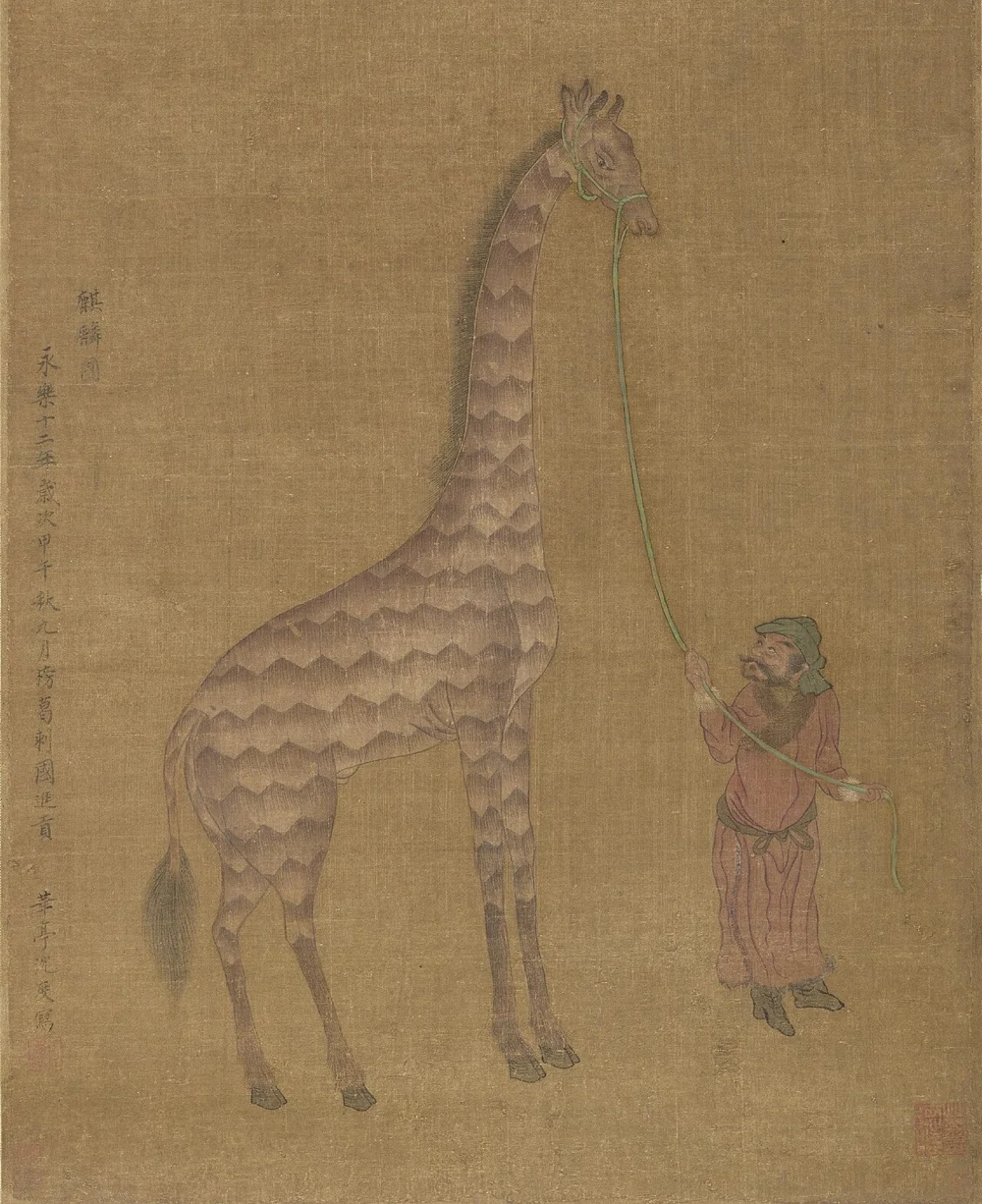 Image: Tribute Giraffe with Attendant, attributed to Shen Du (Philadelphia Museum of Art), public domain, via Wikimedia Commons
In 1414 the Ming court received a giraffe as tribute, sent in the name of the king of Bengal, and court officials treated it as a qilin. Zheng He's fleet brought two giraffes back to Nanjing, and the interpreter Ma Huan credited Malindi, in today's Kenya, as the source of the "qilin." The painting above is labeled 麒麟圖, "picture of a qilin," and shows exactly what arrived: a very tall, very real animal on a lead. (The Philadelphia Museum of Art thinks this copy may be a later work by an unknown painter.)
The name stuck outside China, too. Kirin is the Japanese form of the word and the modern Japanese word for giraffe; in Korean, girin also means giraffe. So if you've wondered about qilin vs kirin: same word, same creature, different national art styles, and in two languages, a giraffe at the zoo.
The qilin in Chinese mythology vs the qilin in web novels
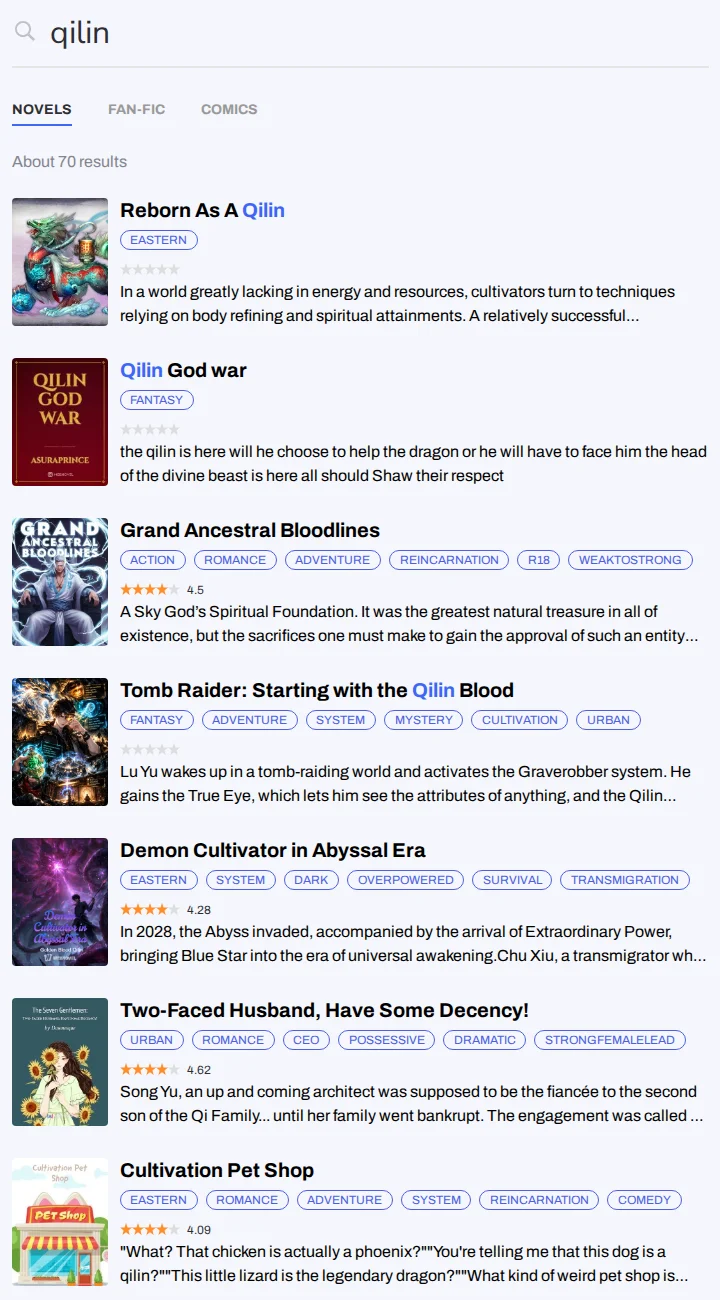 Screenshot: Webnovel search results for "qilin", October 22, 2026
A Webnovel search for "qilin" on October 22 returned about 70 results. We went through the first page of 20. Six put the qilin in the title, and the synopses show the main ways it gets used:
- As a bloodline. In Tomb Raider: Starting with the Qilin Blood, the hero gains "the Qilin Sacred Blood of the Little Brother" through a Graverobber system. Qilin blood is a power-up, the same way a dragon or phoenix bloodline would be.
- As a pet that levels up. Immortal Venerable of the Beast Race sells itself on the spirit beasts its hero rears in a tower, "The Fire Rock Beast transformed into the Fire Qilin." Cultivation Pet Shop plays it for laughs: "You're telling me that this dog is a qilin?"
- As a title. In I Obtain An Immortal Heavenly Technique At The Start, the hero becomes "the Divine Son of Qilin of a noble family" before he's banished.
- As the classic rarity. Translated xianxia also meets the qilin in an idiom, 鳳毛麟角, "phoenix feathers and qilin horns," which means talent so rare you'll hardly see it. Readers have noticed how often geniuses described that way turn up in crowds. One r/noveltranslations user, u/Beltoraze, said the comparison "always confuses me as a means of measuring" and did the math: a qilin has one or two horns, so "there would need to be hundreds of qilin for every phoenix."
Our read: the pet-shop and bloodline uses are fun, but they trade away the one thing that makes a qilin different from a generic dragon-horse. The Liji's qilin calms other beasts and the Zuo Zhuan's qilin is a sign that goes unread. A novel that keeps the qilin rare, kind and hard to recognize is using the myth; one that farms Fire Qilins is using the name.
Where to go next
The qilin sits in a crowded bestiary. If you're reading xianxia for the monsters, our Shan Hai Jing guide covers the book many of them come from, the Kunpeng page covers another classical beast xianxia borrows, and Taowu is the bestiary's idea of a bad omen rather than a good one. For the words around the creatures, the cultivation novel glossary is the quick reference.
How we checked this
On October 22, 2026 we read the qilin passages in Chinese on Wikisource (the Liji "Liyun" chapter and the Zuo Zhuan entry for the fourteenth year of Duke Ai), the English Wikipedia entries for the qilin and the Four Symbols, Wiktionary, the Wikimedia Commons file pages for the images above, the first page of Webnovel's "qilin" search, and two r/noveltranslations threads. We haven't read the novels named in the list; what's said about them comes from their own synopses.
Related Reading
- Kunpeng: The Myth Behind Xianxia's Giant Sky Beasts
- Xuanwu in Chinese Mythology
- Baihu in Chinese Mythology: The White Tiger of the West
- Shan Hai Jing: Classic of Mountains and Seas Explained
- Hundun in Chinese Mythology: The Faceless God of Chaos
References
[1] Wikisource (Chinese): 禮記/禮運 [2] Wikisource (Chinese): 春秋左氏傳/哀公 [3] Wikipedia: Qilin [4] Wikipedia: Four Symbols [5] Wiktionary: 鳳毛麟角 [6] Wikimedia Commons: Tribute Giraffe with Attendant [7] Webnovel: search results for "qilin" [8] r/noveltranslations: If a Peng is a Roc and a Fenghuang is a Phoenix, why isn't a Qilin a Chimera? [9] r/noveltranslations: cultivators rare as qilin horns and phoenix feathers

About the author

Danmei & Genre Explainers Desk
Pen name for NovelBrief's danmei and genre desk: xianxia and xuanhuan conventions, danmei licensing, what a print edition changes.
- Covers danmei, xianxia and xuanhuan, plus genre explainers
- Separates publisher-confirmed facts from fan speculation
- Flags content ratings when the source states them
Keep reading
Hundun in Chinese Mythology: The Faceless God of Chaos
Novels · 7 min
Shan Hai Jing: Classic of Mountains and Seas Explained
Novels · 7 min
Zhuque in Chinese Mythology: The Vermilion Bird of the South
Novels · 10 min
Qinglong in Chinese Mythology: The Azure Dragon of the East
Novels · 9 min
Baihu in Chinese Mythology: The White Tiger of the West
Novels · 7 min
Xuanwu in Chinese Mythology: Star Chart to Living God
Novels · 9 min
Taowu in Chinese Mythology: What Is Taowu, Exactly?
Novels · 7 min
Kunpeng: The Myth Behind Xianxia's Giant Sky Beasts
Novels · 6 min
Disclaimer
This article is published for informational and entertainment purposes. It does not constitute professional financial, legal, or technical advice. Series availability, platform access, translation status, and chapter counts change. Verify critical details (pricing, regional availability, official translation status) with publishers and platforms. Affiliate links, where present, help support our editorial work and are labelled in our affiliate disclosure.
Comments
Loading comments…