Loading…
NovelBrief · Novels
What Is Xuanhuan? The Chinese Fantasy Genre Explained
What is xuanhuan? Learn how this flexible Chinese fantasy genre differs from xianxia, and why its worlds can ignore familiar rules.
5 min readBy Mei-Lin Zhao
What is xuanhuan? It is the useful label for Chinese fantasy that does not need to obey the historical, religious, or cosmological rules readers expect from xianxia. If you want immortal sects and Daoist-flavored ascent, start with our xianxia primer. If you want a fantasy world that can borrow cultivation, demons, empires, and invented physics at once, xuanhuan is the better shelf.
TL;DR: What is xuanhuan? It is Chinese fantasy with room to invent its own world rules. Read xianxia for cultivation toward transcendence; read xuanhuan when the setting can rewrite that framework.
Key Takeaways
- Xuanhuan (玄幻) is a broad Chinese fantasy category, not a promise of one fixed power system.
- It can borrow cultivation language while setting its story in an entirely invented world.
- The useful distinction is not whether characters become powerful. It is whether immortality and Daoist cosmology organize the story.
- Platform tags help, but a novel's opening arc usually tells you more than a marketing label.
Overview
The literal sense of xuanhuan points toward mystery and fantasy. In online-fiction use, it became a large container for stories based on magic and imagination. A recent genre introduction from Wuxiaworld lists it alongside xianxia and wuxia rather than treating the three as interchangeable. That split matters because English discussions often use “cultivation novel” for all of them.
Xuanhuan can have qi, ranked realms, spirit beasts, and ancient clans. None of those pieces settles the question. A story becomes recognizably xuanhuan when its author has freedom to build a secondary world without making the pursuit of immortality or a Chinese mythic order the main organizing principle. A university study of Chinese online literature describes xuanhuan as fiction built around magic and imagination, including invented worlds and power struggles. That is a wider canvas than the word “cultivation” suggests.
What Is Xuanhuan in Practice?
Xuanhuan is best read as a setting-and-rules signal. The protagonist may climb a ladder of power, but the ladder can lead to a dragon empire, an alternate planet, a magical academy, or a continent with its own gods. An author can introduce Western-style monsters, game-like interfaces, or science-fiction machinery without the genre label becoming contradictory.
That freedom is why simple checklists mislead. Flying swords do not automatically make a novel xianxia. Nor does a level system automatically make it LitRPG. Ask three questions instead:
- Does the story explain power through an inherited cultivation cosmology, or through rules it invents for this world?
- Is transcendence the central goal, or one tool inside a larger political, military, or adventure plot?
- Would replacing the sects with kingdoms or academies change the story's identity?
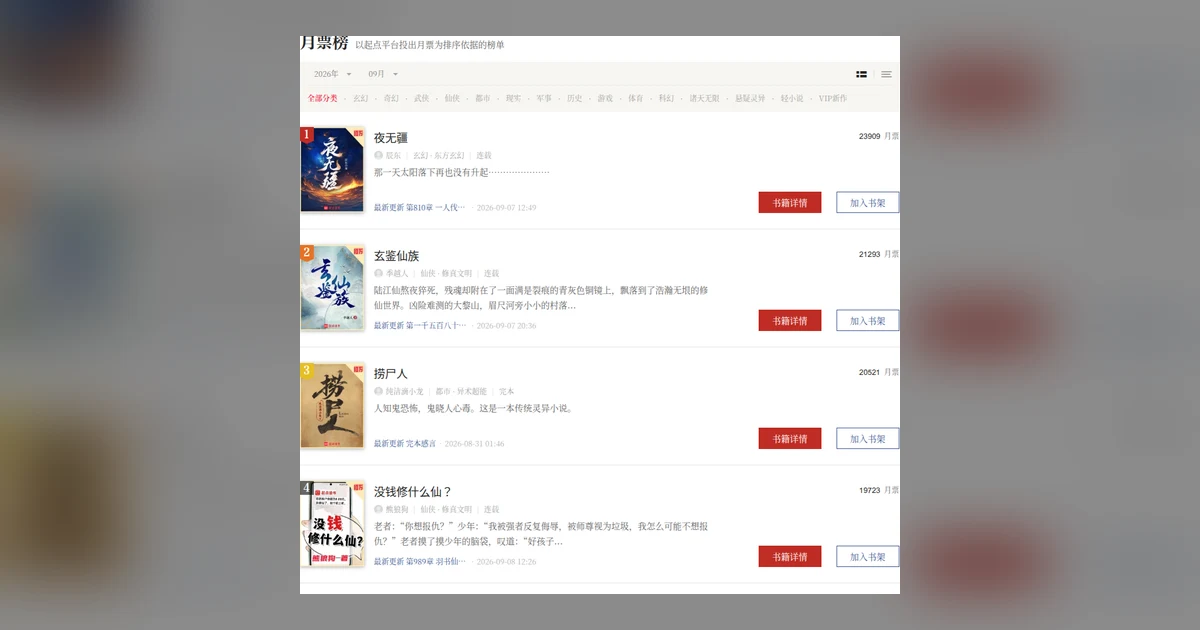
If the third answer is “not much,” you are probably closer to xuanhuan. This is also why a reader should not choose a book solely from the category tab. The Qidian Monthly Vote ranking guide explains what a chart measures; it cannot tell you which version of fantasy you actually want to read.
Xianxia has clearer mythic commitments than this broader category.
What Is Xianxia? →
Xuanhuan vs Xianxia
Xianxia starts with an aspiration: mortals cultivate toward a state beyond ordinary human life. Tribulations, sect lineages, alchemy, and the Dao are not decorative; they give the plot its pressure. Xuanhuan can use every one of those props and still take them somewhere else. Its world may treat immortals as one species among many, or replace the Dao with a wholly invented metaphysics.
The more useful distinction is how much genre baggage a reader wants. Pick xianxia when you want the pleasure of familiar cultivation conventions being played straight, reversed, or argued over. Pick xuanhuan when you want the author to change the furniture entirely. Neither choice guarantees better prose or pacing. It tells you what sort of promises the opening chapters are likely to make.
Rankings are useful only after you know what they rank.
How Qidian Monthly Vote Works →
How to Choose Your First Xuanhuan Novel
Start with the premise, not a maximal chapter count. Look for an official synopsis and confirm whether the English edition identifies its publisher or translator. Then read enough of the opening to find the story's real engine: academy rivalry, clan politics, exploration, revenge, or power progression. A sprawling map is not an argument for committing hundreds of chapters.
Keep one other warning in mind. English catalog tags are inconsistent across platforms. Treat them as a route to a sample, not a verdict. If the story spends its early chapters on meridians, heavenly tribulations, and an eventual ascent, it may be better approached through xianxia expectations even if a site calls it fantasy.
What Is Xuanhuan Asking You to Accept?
The opening should establish which world rules are permanent, which are rumors, and which institutions profit from keeping those rules obscure. A monster hunt, a tournament, and a succession struggle can all belong here if their consequences remain coherent. You do not need a private dictionary before starting. You need to see whether the story has taught you the cost of its own choices.
Frequently Asked Questions
What does xuanhuan mean?
Xuanhuan is a broad Chinese fantasy label for stories built from imaginative or invented settings. It can use cultivation ideas without being tied to Daoist immortality.
Is xuanhuan the same as xianxia?
No. Xianxia centers on cultivation toward transcendence, while xuanhuan has much looser setting and mythology rules.
Do xuanhuan novels have cultivation?
Often, but not always. A xuanhuan story may use ranks, magic, monsters, or a completely invented power system.
Is xuanhuan a Chinese genre?
Yes. The term is used in Chinese online-fiction classification, even when individual stories borrow from many fantasy traditions.
Where can I read xuanhuan in English?
Look for official English editions and platform listings that identify a title's original publisher and translation status.
Related Reading
References
About the author

Danmei & Genre Critic
Danmei and xianxia critic with a background in comparative literature, writing about Chinese web fiction in English since 2019. Toronto-based.
- Writing about danmei and xianxia in English since 2019
- Graduate background in comparative literature
- Tracks the fan-translation-to-official-license pipeline
- Follows Seven Seas' convention announcements directly
Disclaimer
This article is published for informational and entertainment purposes. It does not constitute professional financial, legal, or technical advice. Series availability, platform access, translation status, and chapter counts change. Verify critical details (pricing, regional availability, official translation status) with publishers and platforms. Affiliate links, where present, help support our editorial work and are labelled in our affiliate disclosure.
Comments
Loading comments…