
Qinglong in Chinese Mythology: The Azure Dragon of the East
Qinglong in Chinese mythology is the Azure Dragon of the East, but “dragon” alone is too broad a translation for what the symbol does. Qinglong is one quarter of a directional sky map, a seasonal and elemental correspondence, a guardian in ritual and architecture, and a flexible image that later fiction can turn into a bloodline or a formation anchor. Its meaning comes from the relationships around it.
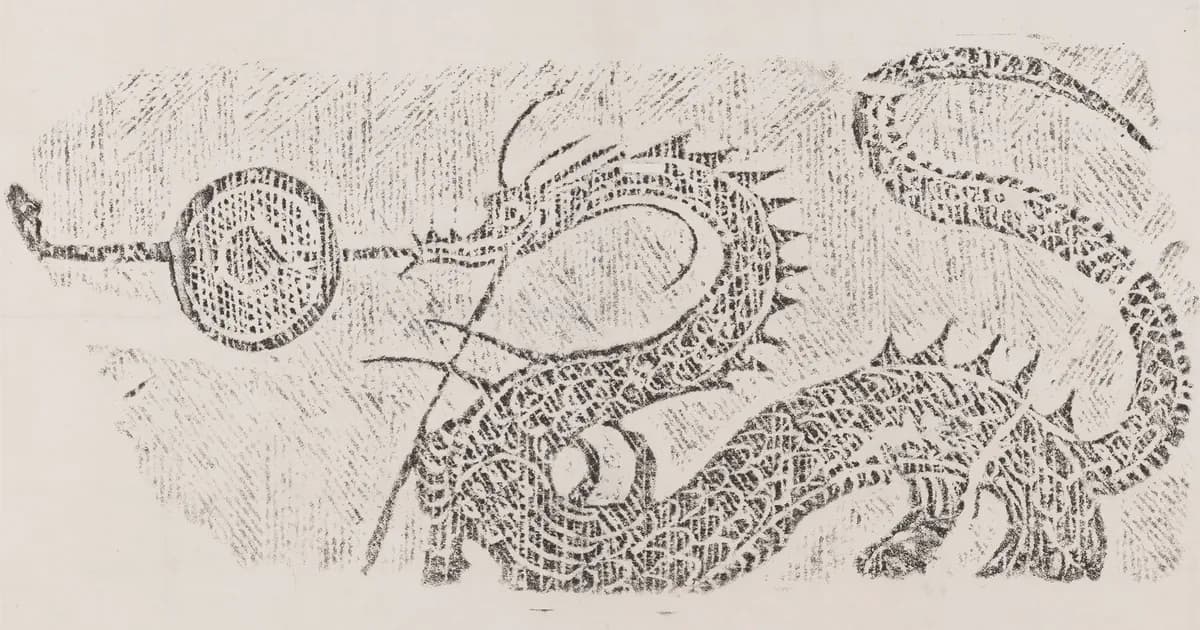
Qinglong in Chinese Mythology: The Four-Symbol Position
Start with the Four Symbols, not with a dragon encyclopedia. Qinglong holds the east, Zhuque (the Vermilion Bird) the south, Baihu (the White Tiger) the west and Xuanwu (the Dark Warrior, or Black Tortoise) the north. Each one is a direction, a slice of sky and a set of correspondences at once.
That makes Qinglong relational. It means something because it sits east of the other three, not because one surviving story gives it a biography. Ellen Van Goethem's peer-reviewed chapter on the four directional animals notes that China, Korea and Japan all identify the Azure Dragon (青龍) as the animal of the left/east, with the Vermilion Bird front/south, the White Tiger right/west and the Black Turtle-Snake back/north. She also points out that the earliest divination texts stay vague about which landscape features stand for each animal, and that at least two traditions grew up later.
That's a useful warning for fantasy readers. A novel can use the left/east layout for a formation, put the four beasts on gates, or just borrow a dragon's name. Ask which layer the story is using before you assume there's one fixed “Qinglong power.”
Read Baihu in Chinese mythology for the western counterpart. Baihu's autumn and metal associations show how a Four Symbols figure changes when its direction changes.
Qinglong's Sky: Seven Eastern Lunar Mansions
The star layer is the heart of it. The Hong Kong Space Museum's glossary of Chinese star regions lists seven mansions under the Azure Dragon: Horn, Neck, Root, Room, Heart, Tail and Winnowing-basket (角, 亢, 氐, 房, 心, 尾, 箕). It describes the twenty-eight mansions as “the regions near the ecliptic and the lunar path, where the Sun, the Moon and the planets pass by.”
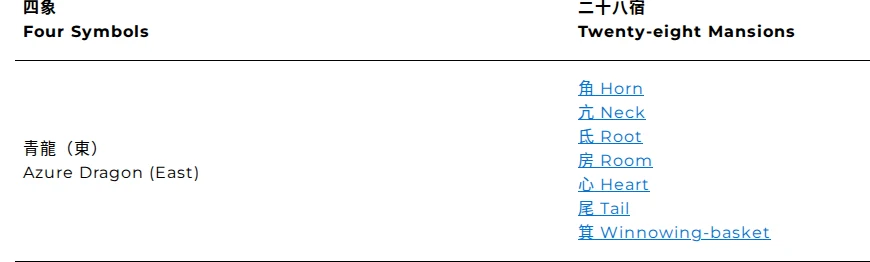 Screenshot: Hong Kong Space Museum, English-Chinese Glossary of Chinese Star Regions, Asterisms and Star Names
So Qinglong groups stars before it's a creature in a cultivation bestiary. The National Palace Museum in Taipei says the same in its Mythical Creatures exhibition: people divided the sky into four sections of seven constellations each, the Four Symbols later became names for the four cardinal directions, and later still guardian beasts. The museum adds that the Azure Dragon is “sometimes also called” Canglong, the Blue-Green Dragon.
A reader in r/ChineseHistory put the consequence bluntly. Answering a student who couldn't find much on the Azure Dragon, u/stevapalooza wrote that “There isn't much lore about the Azure Dragon as a mythological creature” because “it was never believed to be an actual dragon, just a symbol.” We think that's the most useful thing to know about Qinglong: the sky sector is old and fixed, the personality is thin, and novelists are writing on a nearly empty page.
Spring, Wood, and the Color Blue-Green
The east also carries a season and a phase. The National Palace Museum notes that in the Five Elements system “green corresponds to the element wood.” A Henan Museum essay on a Western Han four-spirits pot gives each beast a season: “The Azure Dragon is a symbol of spring,” the White Tiger of fall, the Black Tortoise of winter and the Vermilion Bird of summer. Marianna Lázár's study of Han tomb art dates the system: the four figures became “codified within the cosmological frameworks of yin-yang and Five Phases theory” during the Western Han.
Read those correspondences as a system, not a personality test. Spring suggests growth and rising movement; wood suggests branching and vitality. Neither proves that every Qinglong is gentle. A battle novel can use the same chart for a spear that “grows” through an opponent's guard.
Color needs care too. “Azure” and “blue-green” are both attempts at 青, which doesn't map onto one modern English color. u/random_agency's reply in the same thread is the short version: “青 can be either Blue or Green, the character meaning changed over time.” That's why the same figure turns up as the Green Dragon, the Blue Dragon and the Azure Dragon. The museum rubbing used as this page's cover is black and white because it's a rubbing; the Western Han painting below shows a pale green dragon on a red ground.
Material Evidence: Tombs, Tiles, and Directional Space
The Four Symbols weren't only ideas on paper. The Henan Museum's essay on a covered painted pottery pot with Four Spirits Pattern, a pot dug from a Han tomb at Shaogou in Luoyang in 1953, says the pattern “matured preliminarily in the Western and Eastern Han Dynasties” and was used on burial objects “as an auspicious sign.” From the Warring States period through the Qin and Han, it adds, the four spirits gave their names to palace gates, halls and towers, and decorated eaves, tiles and everyday utensils.
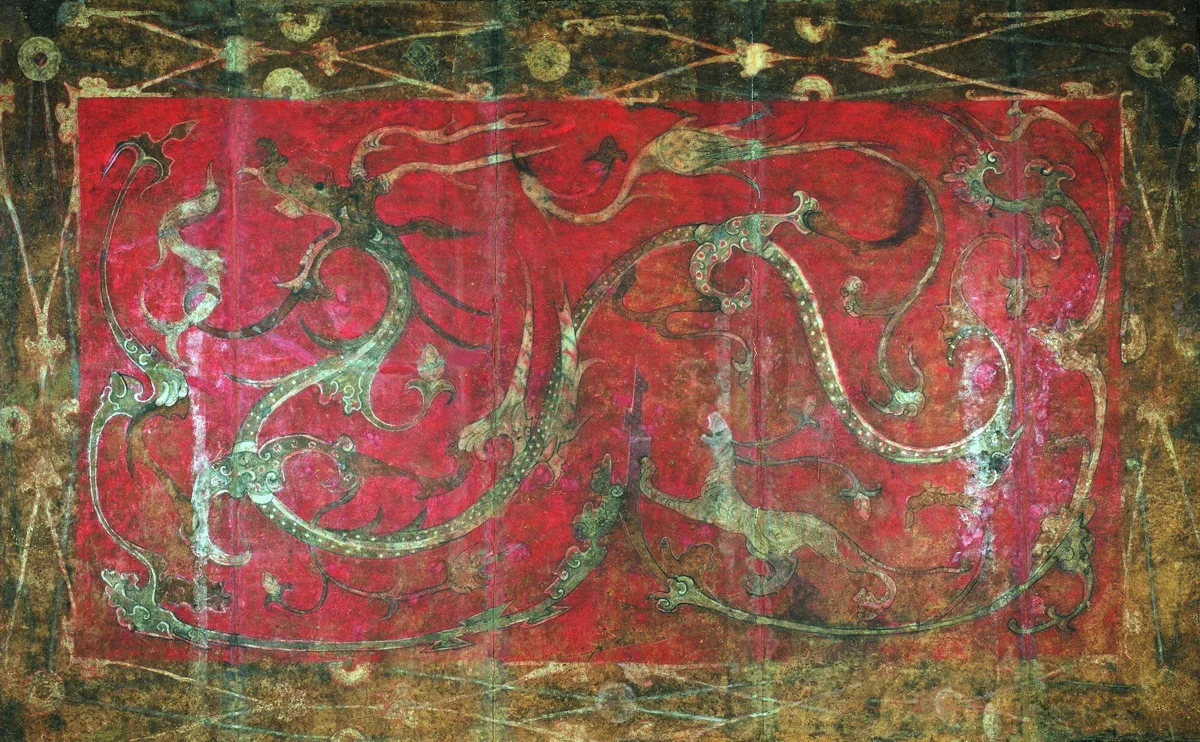 Image: Wikimedia Commons, public domain. Four Spirits and clouds painting (四神云气图), Western Han tomb of Liu Mai, Prince Gong of Liang
In a tomb, then, Qinglong wasn't a lone dragon on a scroll. It marked one side of a building or one quarter of a burial design. Lázár argues that the four deities went into elite tombs to convey “cosmic order, celestial harmony, protection, guidance, and immortality,” and that in Han belief “the tomb was a microcosm of the universe.”
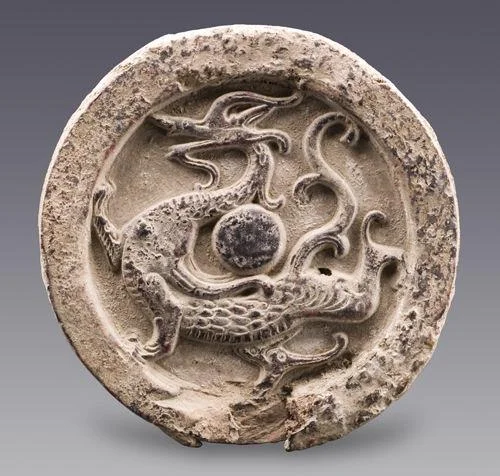 Image: Wikimedia Commons, 沃德利成書畫院, CC BY-SA 4.0
No single pose survives. Body shape, scale and the dragon's place among the other three change from object to object. The National Palace Museum describes the Han relief behind its rubbing as having “a small head and a fluid, agile body,” which it calls typical of Han dragons. That variety isn't a flaw in the myth. It shows a symbol adapted to every material people had.
Qinglong in Chinese Mythology and Xianxia Fiction
Because the lore is so thin, xianxia writers use Qinglong in Chinese mythology as compressed worldbuilding. An eastern gate guarded by an Azure Dragon tells you where a formation points. A spring-wood bloodline signals renewal, growth or a particular qi affinity. A sect that invokes all Four Symbols is often borrowing architecture and astronomy rather than staging four separate boss fights.
The uses we like best leave at least one relationship visible. A Qinglong technique that grows along branching meridians, wakes at dawn or anchors the eastern quarter of a city is using the tradition. So is a character who has to bargain with the symbol as a guardian instead of beating it.
The weakest use treats “Azure Dragon” as a generic upgrade tier. That's fine for a fast progression story; it just isn't the whole tradition. What is xianxia? explains why spirit beasts, qi and ascension vocabulary surround these images, and what is xuanhuan? helps when a story drops Qinglong into a broader fantasy setting where the Four Symbols are no longer a complete cosmology.
Compare the eastern symbol with Zhuque in Chinese mythology. Zhuque holds the south and summer, so the contrast shows how direction changes color, season, element and narrative temperature.
Qinglong Is Not Every Dragon
Qinglong isn't simply the Chinese version of a Western dragon. Western dragon categories usually start from species, anatomy, treasure or breath weapon. Qinglong starts from a sky sector and a directional system. A novel can blend the two, but it helps to notice when it's happening.
The Dragon King question is where readers split. By definition the astral Azure Dragon and Ao Guang, the Dragon King of the East Sea in Journey to the West and Fengshen Yanyi, answer different questions: one is a quarter of the sky, the other a sea god with a palace and sons. In practice they blur, and u/Shockh wrote in the same thread that “Qinglong is often considered to be the same being as Ao Guang.” We'd read a novel that merges them as making a choice, not a mistake, and keep the two apart when you're trying to work out where the symbol came from.
Finally, Qinglong isn't the Chinese-zodiac dragon. The zodiac is a twelve-animal cycle of years; the Four Symbols organize four directions and their stars. Being born in a dragon year doesn't make anyone an incarnation of the Azure Dragon.
Our Take
Treat Qinglong as an address before a creature: east, spring, wood, seven mansions. When a novel uses any of those, the name is doing work. When it doesn't, it's a prestige label, and that's allowed. If you want the full set, Baihu, Zhuque and Xuanwu below follow the same pattern from the other three directions.
Related Reading
- Baihu in Chinese Mythology: The White Tiger of the West
- Zhuque in Chinese Mythology: The Vermilion Bird of the South
- Xuanwu in Chinese Mythology: Star Chart to Living God
- Kunpeng in Chinese Mythology
- Taowu in Chinese Mythology
- What Is Xianxia? A Beginner's Guide
References
- National Palace Museum: What Powers Do Mythical Creatures Possess?
- Hong Kong Space Museum: English-Chinese Glossary of Chinese Star Regions
- Kyushu University: The Four Directional Animals in East Asia
- Marianna Lázár, Animating the Cosmos
- Henan Museum: Covered Painted Pottery Pot with Four Spirits Pattern
- r/ChineseHistory: Need help researching the Azure Dragon in Chinese Myth
- Wikimedia Commons: Four Spirits and clouds painting, tomb of Liu Mai
- Wikimedia Commons: Azure Dragon eave tile


About the author

Danmei & Genre Explainers Desk
Pen name for NovelBrief's danmei and genre desk: xianxia and xuanhuan conventions, danmei licensing, what a print edition changes.
- Covers danmei, xianxia and xuanhuan, plus genre explainers
- Separates publisher-confirmed facts from fan speculation
- Flags content ratings when the source states them
Keep reading
Zhuque in Chinese Mythology: The Vermilion Bird of the South
Novels · 10 min
Baihu in Chinese Mythology: The White Tiger of the West
Novels · 7 min
Xuanwu in Chinese Mythology: The Black Tortoise, Then a God
Novels · 9 min
Shan Hai Jing: Classic of Mountains and Seas Explained
Novels · 7 min
Taowu in Chinese Mythology: A Four Perils Beast, Once a Man
Novels · 8 min
Kunpeng: The Myth Behind Xianxia's Giant Sky Beasts
Novels · 6 min

Qilin in Chinese Mythology: Why Xianxia Turned It Into a Pet
Novels · 7 min
Hundun in Chinese Mythology: The Faceless God of Chaos
Novels · 7 min
Disclaimer
This article is published for informational and entertainment purposes. It does not constitute professional financial, legal, or technical advice. Series availability, platform access, translation status, and chapter counts change. Verify critical details (pricing, regional availability, official translation status) with publishers and platforms. Affiliate links, where present, help support our editorial work and are labelled in our affiliate disclosure.