
Shan Hai Jing: Classic of Mountains and Seas Explained
It looks like a monster manual. It reads like a route map with side effects, and that's how to read it.
Verdict: Start with the first Southern Mountain route on Wikisource and read it as a walk, not a bestiary: place, distance, then what each plant or beast does to you. Skip the creature lists until you've done one route.
The Shan Hai Jing, or Classic of Mountains and Seas, is easiest to read as a route map with side effects. Each entry walks to a mountain, gives a distance, and says what grows or lives there and what it does to you if you eat it, wear it or see it. Start with one mountain route, not a creature list, and the book makes sense fast.
It's easy to meet it backwards. A xianxia novel drops a beast name "from the Shan Hai Jing", the name sounds ancient, and the original entry never comes up. This guide goes the other way: what the book is, the order its sections run in, what one entry actually says, and where to read it for free.
What the Shan Hai Jing Is
Wikipedia calls it "a Chinese classic text and a compilation of mythic geography and beasts". Early versions go back to the 4th century BCE, but the present form "was not reached until the early Han dynasty", and the book covers over 550 mountains and 300 channels. Wikipedia also notes that each chapter "follows roughly the same formula" and that its many short myths "rarely exceed a paragraph".
Nobody knows who wrote it. Wikipedia says the debate since Sima Qian "has been going on for more than two thousand years". Liu Xiu of the Western Han named Yu the Great and Boyi; scholars after the Tang dynasty doubted that; the Qing scholar Bi Yuan argued that different sections had different authors. Most contemporary scholars, Wikipedia adds, treat it primarily as a geography book, while the Qing imperial catalogue filed it under fiction.
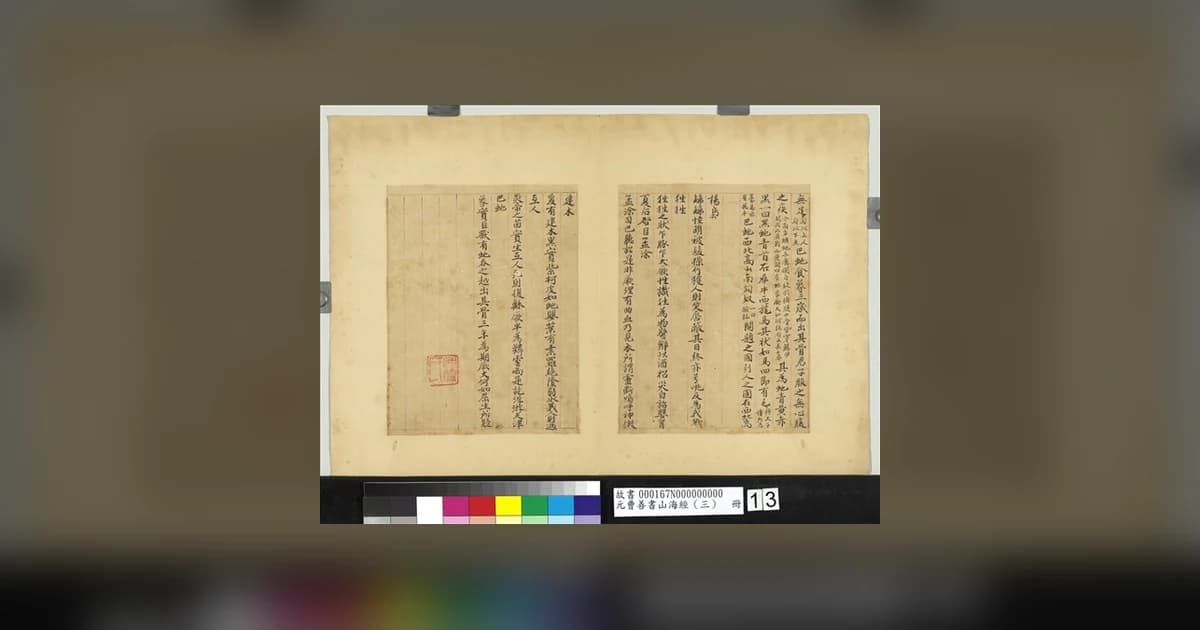
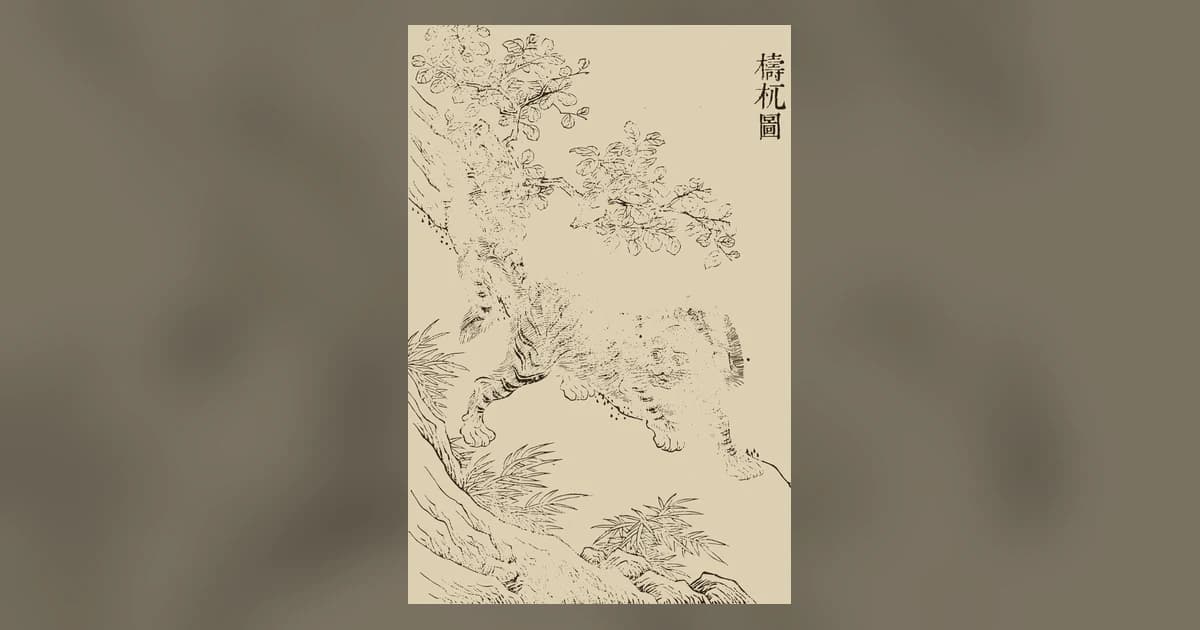
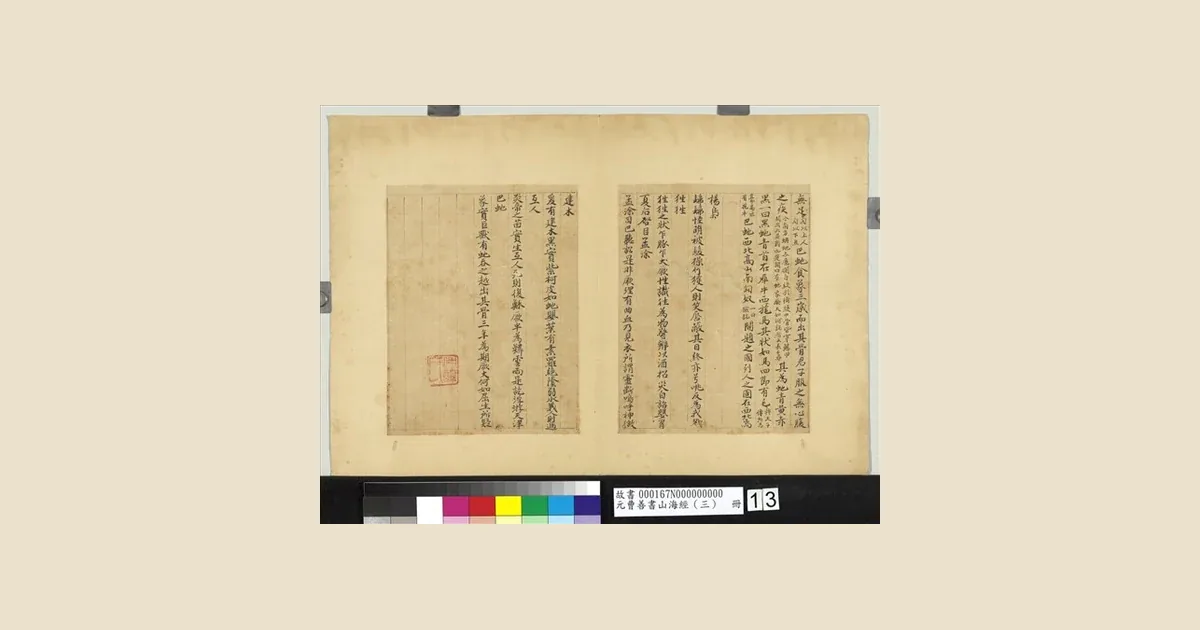 Image: National Palace Museum, Taipei, open image (CC0 at 1 megapixel, CC BY 4.0 at 6 megapixels). Third album of Cao Shan's Yuan-period copy, collection record.
Shan Hai Jing Reading Order: The 18 Sections
The Wikisource edition lists eighteen sections in two groups, and reading them in that order is the simplest plan.
- Mountain Classics (sections 1 to 5): Southern, Western, Northern, Eastern and Central. These walk a route one peak at a time. Start here.
- Regions beyond the seas (6 to 9) and regions within the seas (10 to 13): peoples and places, no longer one mountain chain.
- Great Wilderness (14 to 17): East, South, West and North. The scale opens up again.
- Classic of Regions Within the Seas (18): the last section. Wikipedia notes that the account of Yu the Great controlling the flood sits here.
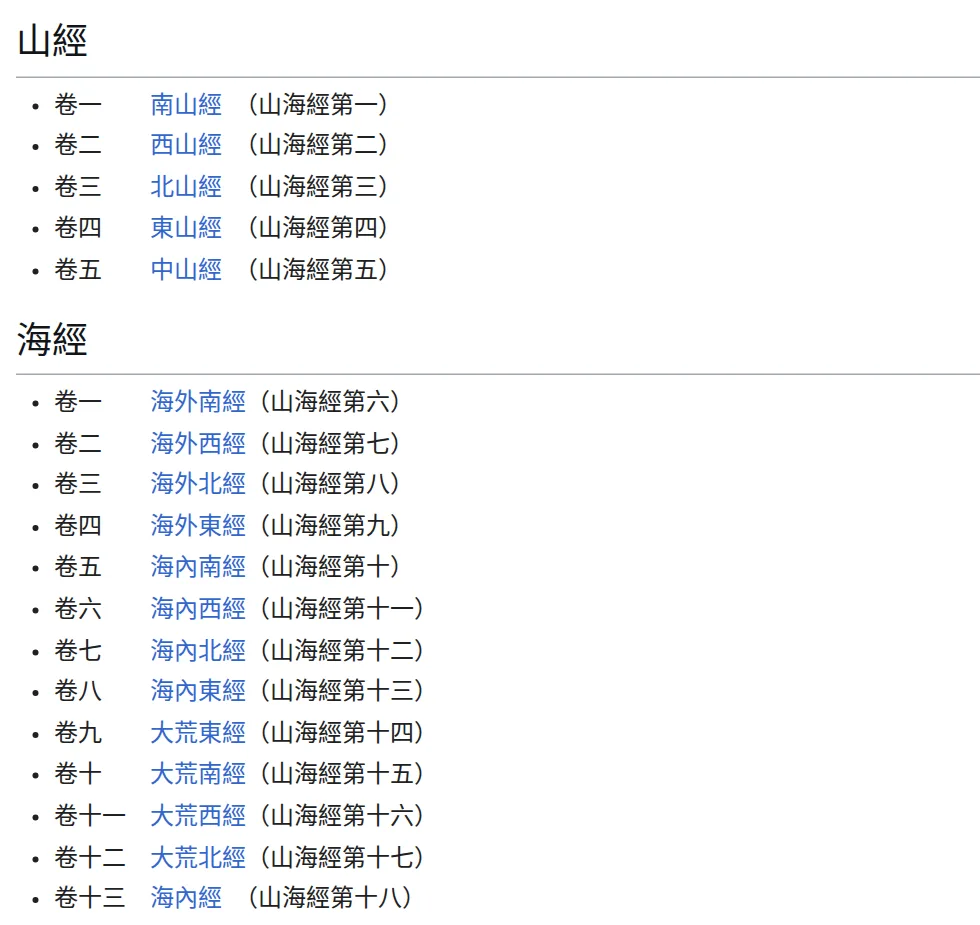 Screenshot: Wikisource, Shan Hai Jing table of contents, taken October 8, 2026 (text CC BY-SA 4.0).
Our advice: do one Mountain Classic, then jump to one Great Wilderness section to feel the change in scale. Starting with the Sea Classics is harder, because the route structure that makes the book readable is gone.
One Route, Read Closely
We read the first Southern Mountain route on Wikisource on October 19, 2026, and it shows the method better than any summary. It opens: "南山經之首曰䧿山。其首曰招搖之山,臨於西海之上". In our rough translation: the first of the Southern Mountains is Que Mountain, and its first peak is Zhaoyao, overlooking the Western Sea, with much cassia, gold and jade.
Then three things, each with a use attached:
- A plant like chives with blue-green flowers, "其名曰祝餘": its name is zhuyu, and eating it keeps you from hunger.
- A tree like the paper mulberry with dark grain and shining flowers, "其名曰迷穀,佩之不迷": its name is migu, and wearing it keeps you from getting lost.
- A beast like a monkey with white ears that walks like a person, the xingxing: "食之善走", eat it and you run well.
Then "又東三百里", three hundred li further east, and the next mountain. The route closes with a tally, "凡十山,二千九百五十里": ten mountains, two thousand nine hundred and fifty li in all, followed by its god, bird-bodied and dragon-headed, and the rites owed to it.
That closing tally is what surprised us most. The book counts its own road. Every animal on it is a place, a body and an effect, and none of them is a boss with a power level. Start from a creature list and you lose exactly the part the text cares about.
Manman: Why Names Drift
A post on r/mythology in September 2026 picked one entry from the Western Mountains and asked what it means now. The poster quotes Manman at Mount Chongwu as a bird "shaped like a wild duck, with one wing and one eye", which "can only fly when it finds its partner", and "when it appears, the world floods." The Wikisource text matches: "有鳥焉,其狀如鳧,而一翼一目,相得乃飛,名曰蠻蠻".
The poster, who says "we're a small team making Mountains and Seas Legends Tarot", finds the double meaning striking: "One image, two incomplete beings joining to fly, can evoke catastrophe in one context and devotion in another." The romance isn't a modern add-on. In the Wikisource text, the commentary right after the name reads "比翼鳥也": this is the paired-wing bird, the image later love poetry made famous. So the old annotators had already tied the flood omen to the lovers' bird.
That's the trap for fantasy readers. When a novel or game uses a Shan Hai Jing creature, check whether the omen came along. A Manman that only stands for love has dropped half its entry.
Compare Taowu in Chinese Mythology for a creature whose name also travelled away from its first text and changed meaning on the way.
Names in Novels: Check the Entry
In fiction, names like Kunpeng, Baihu or Xuanwu can arrive already attached to a power ranking. The source text asks different questions: where is it, what does it look like, what does it do to the person who meets it? Translations don't agree on names either, so a creature can show up as an English description, a transliteration or a later popular name. A novel that borrows "Baihu" or "Qinglong" is inviting a comparison, not proving it follows an entry. One current web novel builds its whole premise on the book: in Radiant Blade of the Wilderness, every Shan Hai Jing beast was eaten long ago and only the martial arts they left behind remain (our Radiant Blade of the Wilderness review).
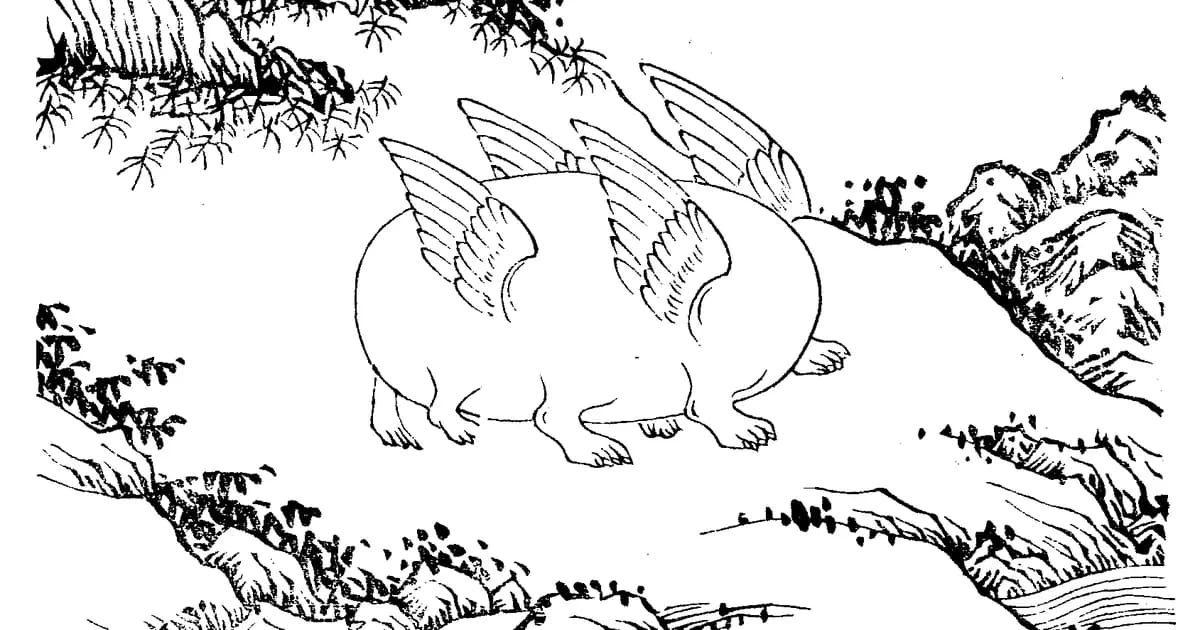
Our Baihu explanation and Qinglong explanation keep those symbols in their own historical lanes, and Kunpeng in Chinese mythology follows a creature with a different source history again. One name gets two opposite judgments: the commentary printed beside the faceless, singing Dijiang of Heaven Mountain ties it to the Zhuangzi's Hundun, while the Zuo Zhuan uses the same name for a banished son (Hundun in Chinese mythology).
Where to Read It, and Which Copy You're Looking At
Free full text: Wikisource's edition is headed "晉郭璞注", annotated by Guo Pu of the Jin, and the commentary sits inline after each phrase. It's in classical Chinese, so pair it with a translation if you need one; the quotes above are our own working versions, not a published translation.
Manuscripts: the National Palace Museum record above is the third album of a Yuan-period copy by the calligrapher Cao Shan (曹善), in regular script (楷書), twenty-one leaves (二十一開). It dates one copy, not the work.
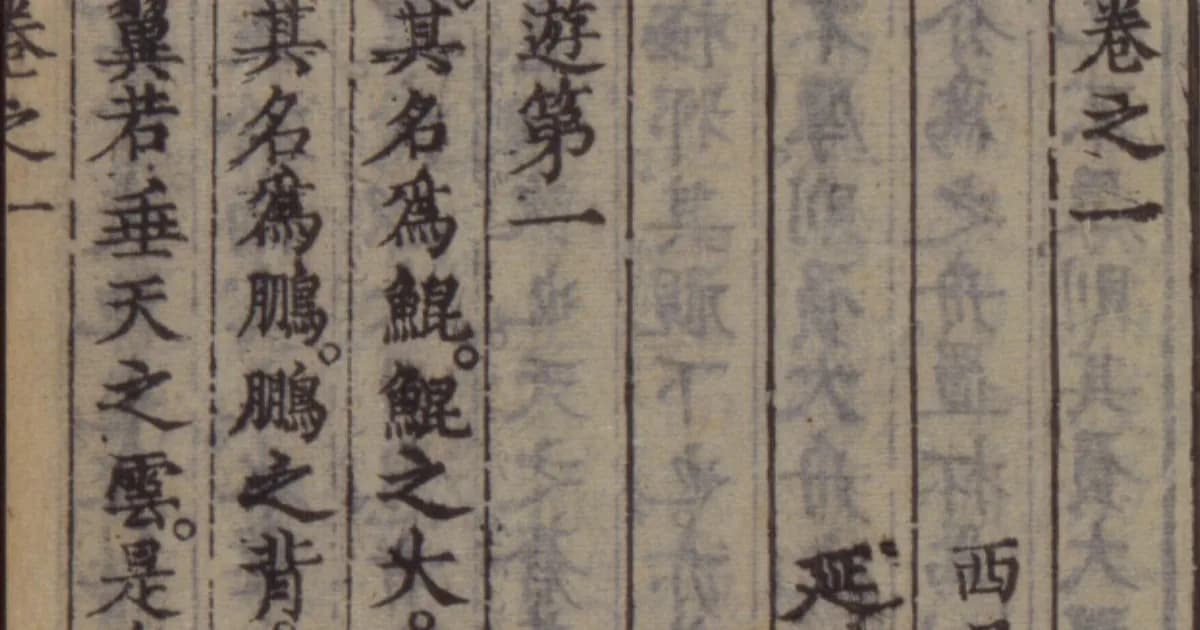
Illustrated editions: the Library of Congress has a later woodblock edition that prints Guo Pu's commentary with pictures. Many of the creature drawings you see online come from editions like this, not from some single ancient picture book.
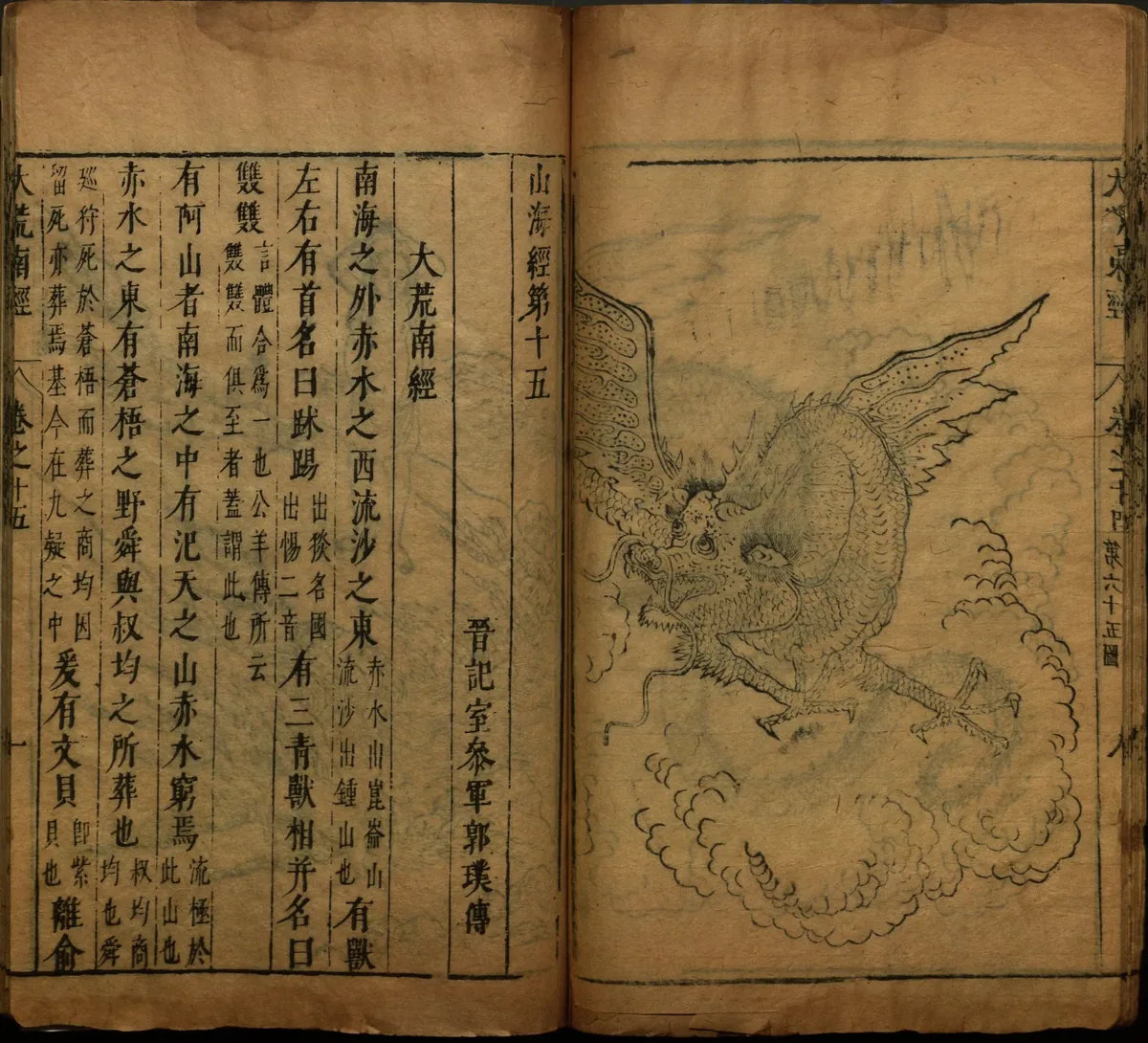 Image: Library of Congress, digitized woodblock edition of the Shan Hai Jing with Guo Pu's commentary, opened to section fifteen, the Great Wilderness South (item).
When you quote an entry, save the section heading with it. That keeps the geography around the name.
Xuanwu in Chinese Mythology shows how a Four Symbols image collected religious, astronomical and fiction meanings beyond any one catalogue entry.
Our Take
Read the Shan Hai Jing as a road, not a zoo. The first Mountain route is only ten mountains long, and after it every borrowed creature in a xianxia novel looks different: you'll notice which authors kept the place and the effect, and which only kept a cool name. Don't try to map its mountains onto real geography on a first read, and don't trust any single picture as "the" original. Keep the omen with the animal and you're reading it the way the text asks.
How We Checked This
On October 19, 2026 we re-read Wikipedia's article, the Wikisource table of contents and the Southern and Western Mountain sections (the first Southern route in full), the National Palace Museum record including its CC0 and CC BY 4.0 download labels, and the r/mythology post through its RSS feed. The Library of Congress page sits behind a bot check, so that image is identified from its own printed section heading, checked against the Wikisource contents.
Related Reading
- Kunpeng in Chinese Mythology
- Taowu in Chinese Mythology
- Xuanwu in Chinese Mythology
- Baihu in Chinese Mythology
- Qinglong in Chinese Mythology
- Zhuque in Chinese Mythology
- Qilin in Chinese Mythology
References
- Wikipedia: Classic of Mountains and Seas
- Wikisource: Shan Hai Jing, table of contents
- Wikisource: Southern Mountain Classic
- Wikisource: Western Mountain Classic
- National Palace Museum digital archive, Cao Shan's Yuan copy
- Library of Congress digitized woodblock edition
- r/mythology: Manman, a one-winged Shan Hai Jing bird that foretold floods
About the author

Danmei & Genre Explainers Desk
Pen name for NovelBrief's danmei and genre desk: xianxia and xuanhuan conventions, danmei licensing, what a print edition changes.
- Covers danmei, xianxia and xuanhuan, plus genre explainers
- Separates publisher-confirmed facts from fan speculation
- Flags content ratings when the source states them
Keep reading
Zhuque in Chinese Mythology: The Vermilion Bird of the South
Novels · 10 min
Qinglong in Chinese Mythology: The Azure Dragon of the East
Novels · 9 min
Baihu in Chinese Mythology: The White Tiger of the West
Novels · 7 min
Xuanwu in Chinese Mythology: The Black Tortoise, Then a God
Novels · 9 min

Qilin in Chinese Mythology: Why Xianxia Turned It Into a Pet
Novels · 7 min
Taowu in Chinese Mythology: A Four Perils Beast, Once a Man
Novels · 8 min
Kunpeng: The Myth Behind Xianxia's Giant Sky Beasts
Novels · 6 min
Hundun in Chinese Mythology: The Faceless God of Chaos
Novels · 7 min
Disclaimer
This article is published for informational and entertainment purposes. It does not constitute professional financial, legal, or technical advice. Series availability, platform access, translation status, and chapter counts change. Verify critical details (pricing, regional availability, official translation status) with publishers and platforms. Affiliate links, where present, help support our editorial work and are labelled in our affiliate disclosure.