Web Novel vs Light Novel: A Reader's Practical Guide
Same story, different edition: the web version is the author's own running text, the light novel is the edited book.
Verdict: In English, read the licensed light novel. Read the web version only if you read Japanese and want the author's text as posted.
Web novel vs light novel comes down to who publishes the text. A web novel is a story the author posts online, usually chapter by chapter, with no publisher in between. A light novel is a publisher's book edition: edited, illustrated, sold in numbered volumes. One story is often both. So the difference isn't "rough" versus "real". It's which edition you're actually opening, and in English that answer also depends on where the story comes from.

Web Novel vs Light Novel: The Core Difference
A web novel goes straight from the author to a site. In Japan, Shosetsuka ni Naro (syosetu.com) calls itself one of the country's largest novel-posting sites. There authors post episodes, readers bookmark and rate them, and nothing stands between the draft and the reader. A light novel is a book: a publisher, an editor, an illustrator, numbered volumes, a release date.
| Web novel | Light novel | |
|---|---|---|
| Where it appears | An author's page on a site like Shosetsuka ni Naro | A publisher's label, in print and ebook |
| Unit | Episodes, posted on the author's schedule | Numbered volumes |
| Who touches the text | The author | Author plus editor |
| Art | Usually none | Cover and interior illustrations |
| How you read it | On the site, episode by episode | Bought per volume, or through a subscription such as J-Novel Club's |
| English route | Japanese web versions are rarely licensed; Chinese serials often are, chapter by chapter | Licensed by publishers such as J-Novel Club |
The "light" in light novel is a market label, not a reading level. Some light-novel series run past thirty volumes.
Three Stories That Became Both
The best way to see the split is to look at series that live in both forms. All three below started on Shosetsuka ni Naro.
| Series | Web version on Shosetsuka ni Naro | Status there |
|---|---|---|
| Ascendance of a Bookworm (本好きの下剋上), Miya Kazuki | September 23, 2013 to March 12, 2017; 677 episodes | Complete |
| Mushoku Tensei (無職転生), Rifujin na Magonote | November 22, 2012 to April 3, 2015; 286 episodes | Complete |
| Re:Zero (Re:ゼロから始める異世界生活), Tappei Nagatsuki | First episode April 20, 2012; latest September 25, 2026; 797 episodes | Still updating |
Two of those web versions are finished, which kills the idea that "web novel" means "unfinished." Bookworm's web text runs to more than five and a half million characters, and Mushoku Tensei's page points to a separate serial for side stories written after it ended.
Re:Zero is the more useful case. Its Syosetu page carries an author's note that the story was published as a book by MF Bunko J on January 24, 2014, and that there are no plans to delete the web version, cut it down to a digest or stop updating it. More than twelve years later the web serial is still going alongside the books. So a light-novel edition doesn't replace the web novel; both can keep moving.
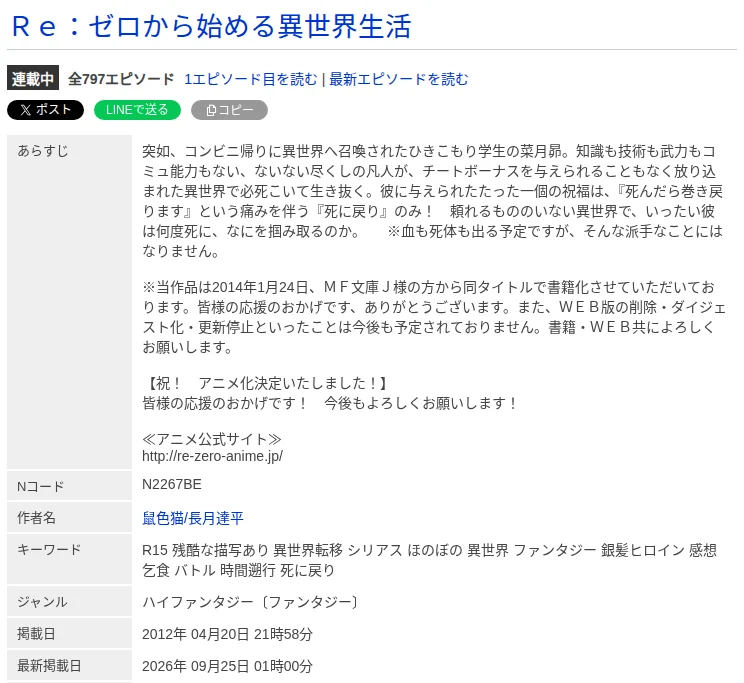 Screenshot: Shosetsuka ni Naro, Re:Zero info page, October 15, 2026
When the Book Rewrites the Web Version
Re:Zero is one pattern: two editions running side by side. The Rising of the Shield Hero is the other. It also started on Shosetsuka ni Naro, but according to Wikipedia's summary of the series, Media Factory's light-novel edition was "re-written with an expanded story-line", with illustrations by Seira Minami. One Peace Books has published that edition in English since September 2015.
This is the case where the label changes what you read. Pick up the Shield Hero web text after the books and you're not reading an early draft of the same plot. You're reading the original that the books rewrote. So before you treat one edition as a shortcut to the other, check whether the series kept the two in step, as Re:Zero has, or rewrote the book.
What Changes in the Light Novel
The edition gets an illustrator and an editor, and in English a translator and a second editor too. J-Novel Club's Bookworm page credits all four: Miya Kazuki as author, You Shiina as illustrator, quof as translator and Kieran Redgewell as editor. It sells the series as numbered parts and volumes, starting with Part 1 Volume 1 in May 2019, and tags it "available in print."
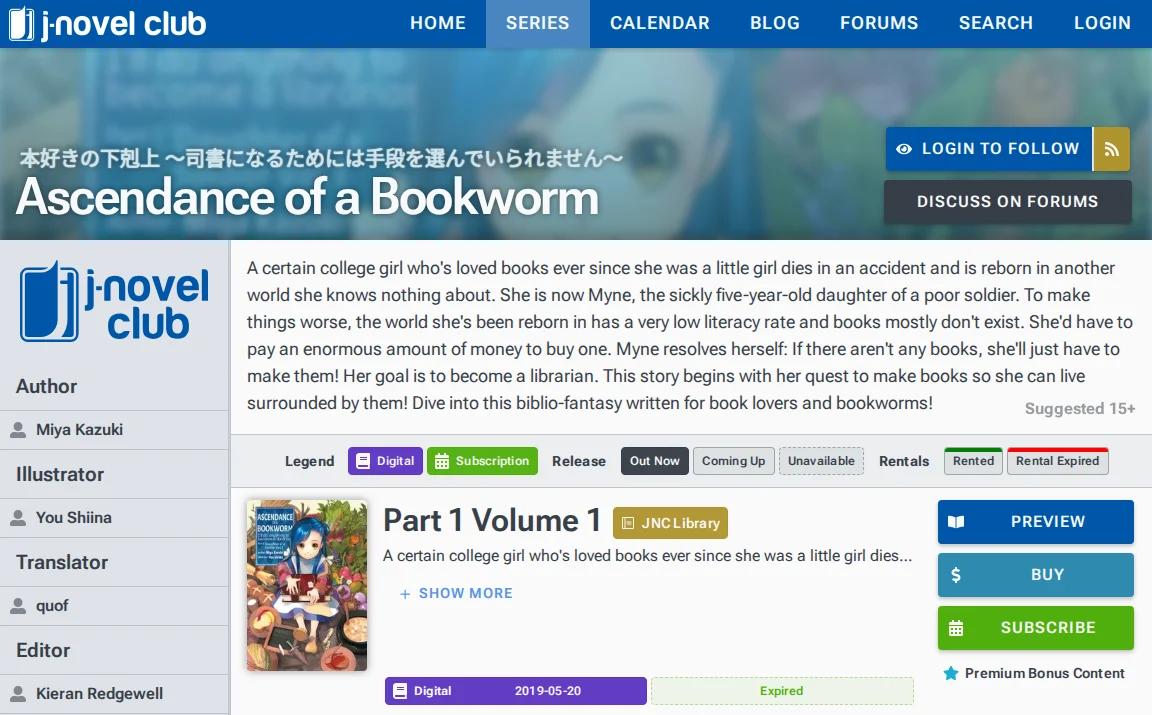 Screenshot: J-Novel Club, Ascendance of a Bookworm series page, October 15, 2026
How much the text itself changes depends on the series. Readers argue about it constantly. In a 2019 r/LightNovels thread about Bookworm, u/BobTheTraitor put the case for the books: light novels “now have to go through an editor and publisher. Whereas the Web Novels just came straight from the Author.” Another commenter, quoting the subreddit's FAQ, went further and called a web novel “essentially a first/rough draft of a Light Novel.”
We'd push back on "rough draft." That's true for some series and wrong for Re:Zero, where the author has kept writing the web version for over a decade. The fair version is that the light novel is the edited edition, and the web novel is the author's own running version. Which one is better is a per-series question.
Reading Chinese serials on the Webnovel app instead? Is the Webnovel app safe? covers accounts, payments and privacy.
Web Novel vs Light Novel: Which Should You Read?
In English, read the light novel when one exists. For Bookworm, the licensed English edition is J-Novel Club's light novel; readers in that 2019 thread who didn't want to wait were weighing fan translations of the web text instead. The licensed edition is the one that pays the author and the one that will still be there next year.
If you read Japanese, the web version is free and sometimes further along. Bookworm's web text was finished in 2017, two years before J-Novel Club's first English volume. Just expect differences from the book you may already own.
Chinese Web Novels Skip the Light-Novel Step
Everything above is the Japanese pipeline. Chinese web fiction works differently. The light-novel label isn't used for these books. The web serial is the original, and the official English edition is usually a web serial too, sold chapter by chapter.
Lord of the Mysteries shows how that looks. Webnovel's catalog lists it as Completed at 1,432 chapters and names the translators and editors, CKtalon and AtlasStudios. That's a licensed English web novel, credits included. For a Chinese title, "it's a web novel" tells you nothing about whether a version is official. The credits do. A few books then get a print edition on top, as with Seven Seas' matrilocal marriage novel, and those come out as novels, not light novels.
New to long online serials? What Is a System Novel? shows how platform labels and story mechanics are different questions.
Our Take
Stop asking which format is "real." Ask which edition you're holding. Check the author credit, the publisher and the volume or episode count on the page in front of you. If it's English and nobody's named as publisher or translator, treat it as unofficial. If it's a licensed light novel, you're reading the edited version, and that's where we'd start.
Related Reading
- Is the Webnovel App Safe?
- What Is a System Novel?
- Reverend Insanity Reading Guide
- Lord of Mysteries Review
- My House of Horrors Review
References
- Shosetsuka ni Naro: Re:Zero info page
- Shosetsuka ni Naro: Ascendance of a Bookworm info page
- Shosetsuka ni Naro: Mushoku Tensei info page
- J-Novel Club: Ascendance of a Bookworm
- r/LightNovels: Question about LN and WN difference
- Wikipedia: The Rising of the Shield Hero
- Webnovel: Lord of the Mysteries catalog
About the author

Danmei & Genre Explainers Desk
Pen name for NovelBrief's danmei and genre desk: xianxia and xuanhuan conventions, danmei licensing, what a print edition changes.
- Covers danmei, xianxia and xuanhuan, plus genre explainers
- Separates publisher-confirmed facts from fan speculation
- Flags content ratings when the source states them
Keep reading
Transmigration vs Reincarnation vs Rebirth in Web Novels
Novels · 8 min
Best Wuxiaworld Novels in 2026, Ranked by Reader Score
Novels · 10 min

Cultivation Novel Genre Fatigue: Has Xianxia Shifted?
Novels · 5 min
Murim vs Wuxia: The Difference Explained for Readers
Novels · 5 min
Kakao Shuts Down Tapas Web Novel Access: Reader Guide
News · 10 min
The Future of Wuxia: Translation Is the Next Fight
Novels · 7 min
Novels Like Lord of the Mysteries, Matched to What You Loved
Novels · 8 min
Hundun in Chinese Mythology: The Faceless God of Chaos
Novels · 7 min
Disclaimer
This article is published for informational and entertainment purposes. It does not constitute professional financial, legal, or technical advice. Series availability, platform access, translation status, and chapter counts change. Verify critical details (pricing, regional availability, official translation status) with publishers and platforms. Affiliate links, where present, help support our editorial work and are labelled in our affiliate disclosure.
Comments
Loading comments…