
Transmigration vs Reincarnation vs Rebirth in Web Novels
One question sorts them all: whose body do you wake up in, and when? Five first chapters show the answers.
Verdict: Transmigration puts you in someone else's body or world, reincarnation starts you over as a baby, and rebirth sends you back into your own younger self. Korean novels call that last one regression.
Transmigration vs reincarnation comes down to one question: whose body do you wake up in, and when? A transmigrator lands in a body or world that was already there. A reincarnated hero dies and starts again as a baby. A reborn hero wakes up as their own younger self, which Korean web novels call regression. Quick transmigration is transmigration on repeat, one world after another. We read the first chapter of a novel from each camp on October 22, and the openings make the differences obvious within a page.

Transmigration vs Reincarnation vs Rebirth at a Glance
| Transmigration | Reincarnation | Rebirth / regression | Quick transmigration | |
|---|---|---|---|---|
| Label you'll see | Transmigration, 穿越 (chuanyue) | Reincarnation | Rebirth, 重生 (chongsheng); regression in Korean novels | Quick transmigration, 快穿 (kuaichuan) |
| Who you become | Someone who already existed, or yourself in a new world | A newborn | Your own younger self | A new body in every world |
| Do you remember? | Yes | Yes | Yes, the whole first life | Yes |
| Opening we read | The Novel's Extra | Damn Reincarnation | Rebirth of the Thief Who Roamed the World | Quick Transmigration: The Mad Beauty Refuses to Be the Scapegoat! |
Where the Words Come From
The English word is older than the genre. Wikipedia's article on reincarnation opens by calling it "also known as rebirth or transmigration." On r/OtomeIsekai, u/ericthefred points out that "originally (meaning before its use in this genre) 'transmigration' was a synonym for 'reincarnation'." Web fiction gave it a narrower job.
The Chinese terms are cleaner. Wuxiaworld's guide to historical web novels says Chinese historical fiction is marked by "the widespread use of time travel (穿越)," and traces it to A Step into the Past, Huang Yi's 1990s novel about "a modern special forces soldier who travels back to the Qin dynasty." Its guide to urban web novels defines rebirth (重生) as a hero who "is reborn several decades into the past and walks the path of life again," a genre it dates to Rebirth Legend by Zhou Xingwen in 2004. Baidu Baike describes quick transmigration as a genre that "emerged as an extension of time-travel novels."
Transmigration: Someone Else's Life, Mid-Story
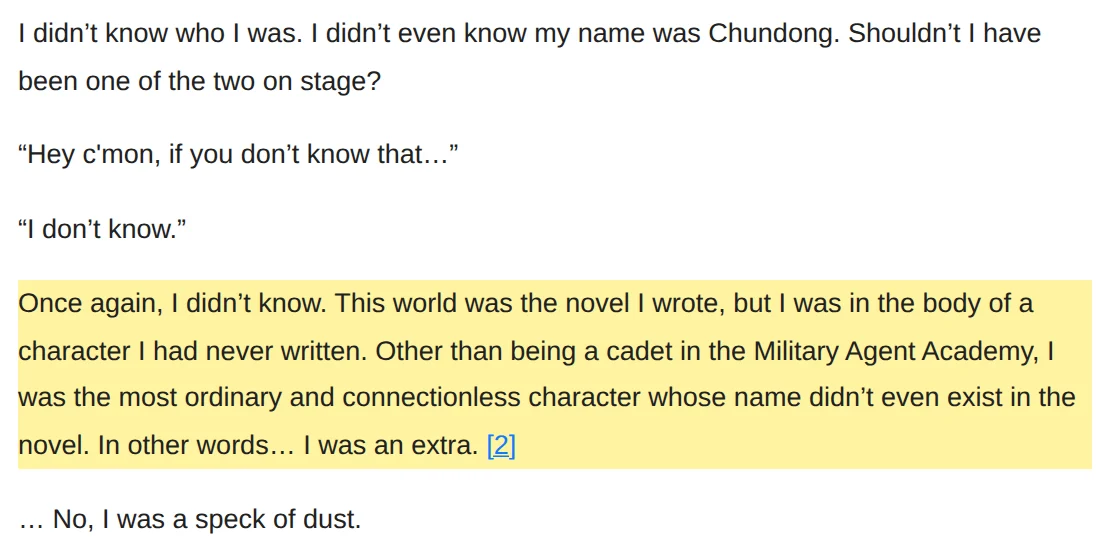 Screenshot: Wuxiaworld (lite reader), The Novel's Extra chapter 0, October 22, 2026, highlight ours
The Novel's Extra, a Korean novel on Wuxiaworld, is the textbook case. In its opening chapter the narrator sits in an academy auditorium watching the two leads of a novel he wrote, then realizes where he is: "This world was the novel I wrote, but I was in the body of a character I had never written." A classmate calls him Chundong, a name he's never heard. That's transmigration in its most common modern form: a body with a past, a world with a plot, and a stranger at the wheel.
It doesn't have to be a person. In The Mirror Legacy, Lu Jiangxian dies after a night of work and wakes at the bottom of a river as "a bluish-gray mirror." Wuxiaworld's series page puts it plainly: "He transmigrated, not as a human but a mirror." The transmigration novels with a female lead we've covered mostly use the book-character version.
The Mirror Legacy Review follows the mirror transmigrator through his first ten chapters and the family he ends up guarding.
Reincarnation: Die, Then Cry Like a Baby
 Screenshot: Wuxiaworld (lite reader), Damn Reincarnation chapter 1, October 22, 2026, highlight ours
Damn Reincarnation spends almost its whole first chapter on a death. The warrior Hamel, chest pierced, tells his companions to leave him, hears a rival thank him for the first time, and dies. The chapter's last two lines are a newborn's "Waaahhhhh." and his own reaction, which we'll leave to you. The series page confirms where he landed: "He was reincarnated as the descendant of his fellow warrior, Vermouth."
That's the heart of transmigration vs reincarnation. A reincarnated hero doesn't borrow a grown-up's life; he gets a childhood, with the old memories riding along. On r/OtomeIsekai, u/happyegg2 draws the same line: the heroine "most definitely died on her previous life and gets reborn as a baby."
Rebirth and Regression: Your Own Life, Second Try
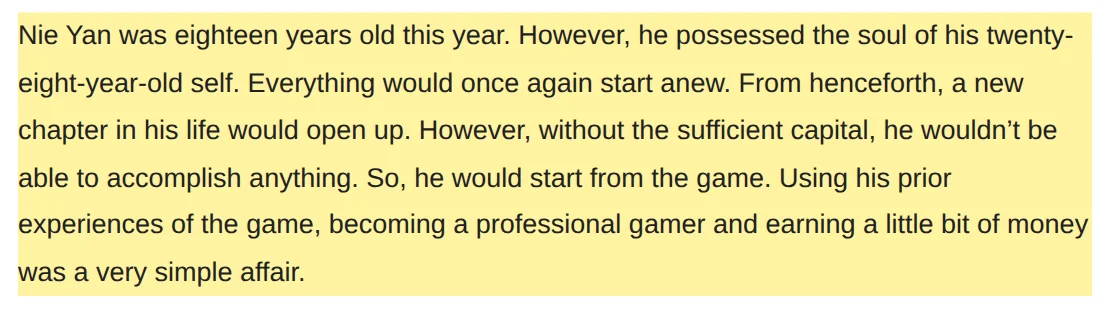 Screenshot: Wuxiaworld (lite reader), Rebirth of the Thief Who Roamed the World chapter 1, October 22, 2026, highlight ours
Rebirth keeps the body and rewinds the clock. In Rebirth of the Thief Who Roamed the World, Nie Yan assassinates his father's enemy, takes "a single bullet" in the back, and wakes up in a room he knows: "Isn't this the house I lived in when I was in high school?" He's eighteen again, with "the soul of his twenty-eight-year-old self," and a decade of game knowledge to cash in. Wuxiaworld's urban guide names the payoff: "a tremendous informational advantage."
The Korean novels on Wuxiaworld use another word for it, regression: Regressor Instruction Manual's blurb mentions "the regressor who went back in time." u/happyegg2's definition of regression is the same move: the heroine "wakes up as herself from couple to several years in the past." Translators blur the labels, though. Later in the same chapter, Rebirth of the Thief's English text refers to "his reincarnation." Go by what happens on the page, not the word on the cover. That settles transmigration vs rebirth, too: a transmigrator borrows someone else's life, and a reborn hero gets their own back. Our best rebirth novels list holds to that strict version, Rebirth of the Thief included.
Quick Transmigration: One World Per Arc
Quick transmigration is transmigration with a schedule. Baidu Baike's entry says the hero, "often equipped with a mission or a system," finishes the job in one world and moves on, with most worlds wrapping up "within twenty to thirty chapters." Quick Transmigration: The Mad Beauty Refuses to Be the Scapegoat! on Webnovel lays out its worlds in the blurb, starting with "The first world: The substitute for Bai Yueguang."
Its first chapter skips the death scene entirely. Jiang Lai is already inside "the original owner," a fresh graduate the male lead treats as a stand-in for someone else. By the end of the chapter a system voice called Little Buding is reporting "task progress is ten percent." That's the shape of the whole genre: short arcs, a scoreboard, and a heroine who knows the plot better than anyone in it.
The voice in Jiang Lai's ear is a system. What Is a System Novel? explains how those companions work.
What Readers Argue About
Transmigration takes most of the heat. On r/noveltranslations, u/91sdia complains that "99% of the time the mc being a transmigrator will have zero relevant or interesting bearing on the rest of the story." u/Futarchy shrugs it off: "It's just an easy way to get the story going." Regression has its own fans. u/ApprehensivePeace305 argues "there's more catharsis in seeing someone get a second chance instead of seeing say, a novel reader fix things."
Transmigration vs Reincarnation vs Rebirth: Which to Read
Our take: pick by the kind of payoff you want. Rebirth and regression give the strongest hook, because the hero's knowledge is personal and the regret is real; start with Rebirth of the Thief if you like game worlds. Reincarnation gives you a whole life to watch, so it suits slow growth stories like Damn Reincarnation. Transmigration is the most flexible and the most abused: when it works, as in The Novel's Extra, the stranger-in-the-story angle is the point. For quick transmigration, our danmei and system-transmigration hub and best danmei transmigration novels are the next stop, and what a system novel is covers the companion voice. If you want a modern mind dropped into a martial world, see our transmigrated-into-murim picks.
Frequently Asked Questions
Q: What is the difference between transmigration and reincarnation? A: In web novel usage, a transmigrator wakes up in a body that already had a life, often a character in a book or game. A reincarnated hero dies and is born again as a baby, keeping the memories of the old life.
Q: Is rebirth the same as regression? A: Mostly. Chinese web novels call it rebirth (重生, chongsheng) when a hero wakes up as their own younger self; Korean web novels usually call the same move regression. Translators don't always keep the labels apart.
Q: What does quick transmigration mean? A: Quick transmigration (快穿, kuaichuan) is a run of short transmigrations: the hero is sent through one world after another, usually with a system or a mission, and moves on once the job in each world is done.
Q: What is transmigration called in Chinese? A: 穿越 (chuanyue). Wuxiaworld's guide to historical web novels translates it as time travel, because so many Chinese historical novels send a modern person into the past.
Q: Did transmigration always mean this? A: No. Outside fiction it's a synonym for reincarnation: Wikipedia defines reincarnation as "also known as rebirth or transmigration." Web novel readers use it for waking up in an existing body or world.
How We Checked This
On October 22, 2026 we read the first chapters of The Novel's Extra, Damn Reincarnation and Rebirth of the Thief Who Roamed the World on Wuxiaworld's lite reader, chapter 1 of Quick Transmigration: The Mad Beauty Refuses to Be the Scapegoat! on Webnovel, and chapter 1 of The Mirror Legacy for our review. We also opened the five series pages (Regressor Instruction Manual's included), Wuxiaworld's historical and urban genre guides, Baidu Baike's quick transmigration entry, Wikipedia's reincarnation article and two Reddit threads.
Related Reading
- The Mirror Legacy Review
- Best Transmigration Novels With a Female Lead (2026)
- Best Danmei Transmigration Novels (2026)
- Best Transmigrated Into Murim Novels
- What Is a System Novel?
- Murim vs Wuxia: The Difference Explained
References
[1] Wuxiaworld: Introduction to Chinese webnovel genres, Historical [2] Wuxiaworld: Introduction to Chinese Webnovel Genres, Urban [3] Baidu Baike: Quick Transmigration [4] Wuxiaworld: The Novel's Extra, chapter 0 [5] Wuxiaworld: Damn Reincarnation, chapter 1 [6] Wuxiaworld: Rebirth of the Thief Who Roamed the World, chapter 1 [7] Webnovel: Quick Transmigration: The Mad Beauty Refuses to Be the Scapegoat! [8] r/OtomeIsekai: Do you prefer transmigration, reincarnation, regression or historical? [9] r/noveltranslations: Anyone else not enjoy transmigration? [10] Wikipedia: Reincarnation [11] Wuxiaworld: Regressor Instruction Manual
About the author

Licensing & Rankings Desk
Pen name for NovelBrief's licensing, rankings and news desk: Seven Seas and Webnovel announcements, Qidian chart moves. Every number is logged with its source page and check date.
- Covers licensing announcements, translation status and chart moves
- Names the ranking board and date range behind every claim
- Every number, date and quote is logged against a source page
Keep reading

Best Transmigration Novels With a Female Lead (2026)
Novels · 7 min

Murim vs Wuxia: The Difference Explained for Readers
Novels · 5 min
Release That Witch Review: Read It for the First Half
Reviews · 8 min

Best Rebirth Novels in English, From Villain to Empress
Novels · 10 min

Transmigrated Into Murim: Novels You Can Read in English
Novels · 7 min

Best Wuxiaworld Novels in 2026, Ranked by Reader Score
Novels · 10 min

Xianxia vs Xuanhuan Difference: A Practical Reader Guide
Novels · 8 min

A Modern Man Transmigrated Into Murim: Where to Read
Novels · 5 min
Disclaimer
This article is published for informational and entertainment purposes. It does not constitute professional financial, legal, or technical advice. Series availability, platform access, translation status, and chapter counts change. Verify critical details (pricing, regional availability, official translation status) with publishers and platforms. Affiliate links, where present, help support our editorial work and are labelled in our affiliate disclosure.
Comments
Loading comments…