Loading…
NovelBrief · Novels
Is Murim Chinese or Korean? Origin and Genre Explained
Is murim Chinese or Korean? The word comes from Chinese wulin, while modern murim fiction is a Korean genre with its own settings and conventions.
8 min readBy Mei-Lin Zhao
TL;DR: Is murim Chinese or Korean? The word is Korean, but its written source is Chinese 武林, pronounced wulin in Mandarin and murim in Korean. Korean writers turned that borrowed martial-world vocabulary into a distinct modern fiction tradition, so the most accurate answer is “Chinese linguistic root, Korean genre practice.”
Key Takeaways
- Murim (무림) is the Korean pronunciation of the Chinese characters 武林, usually rendered as wulin in English.
- Wulin names a community or world of martial artists, not a country or a complete genre by itself.
- Wuxia is a Chinese genre; murim is a Korean storytelling tradition that developed through adaptation and local convention.
- A murim story can use Chinese-inspired sects while still being Korean in authorship, format, pacing, and character priorities.
- Labels describe tendencies, not guarantees. A murim tag cannot promise historical accuracy, Korean geography, or a specific power ceiling.
Is Murim Chinese or Korean? Start With the Word
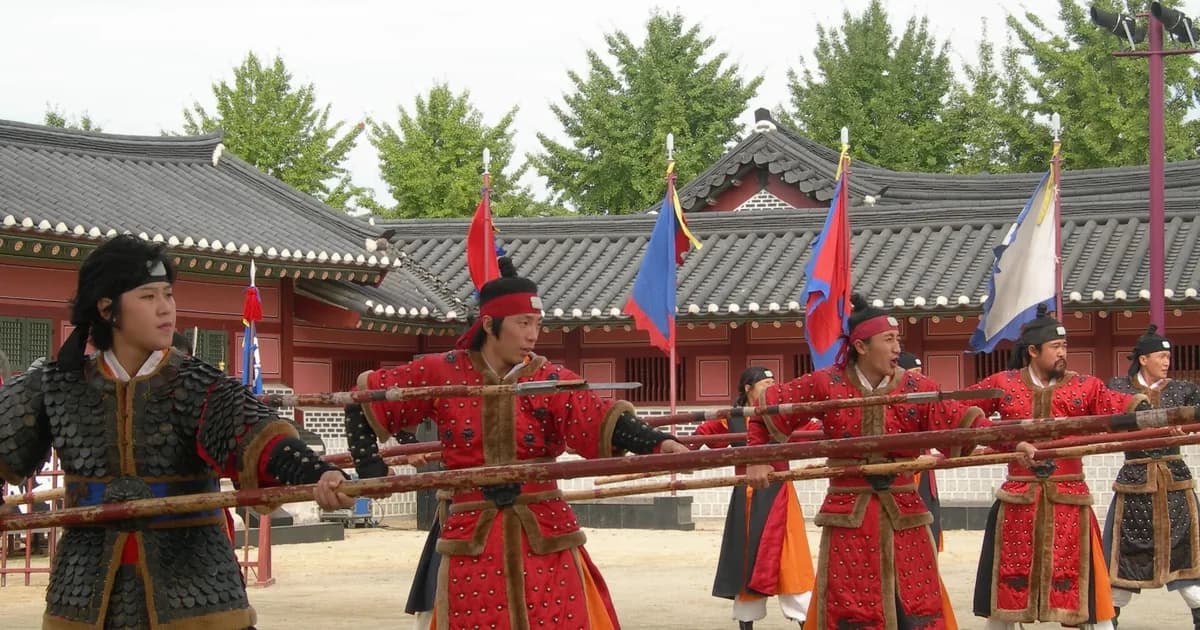
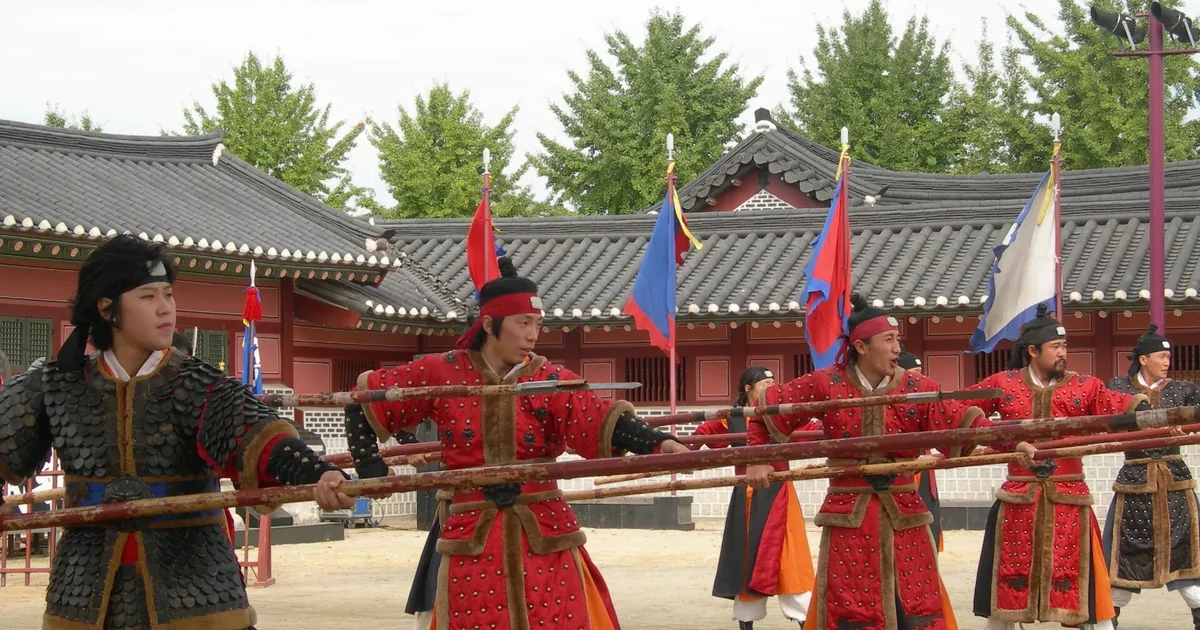 Republic of Korea performers at Suwon Haenggung Palace, photographed by the Republic of Korea and shared on Wikimedia Commons under CC BY-SA 2.0. The photograph is a real Korean martial-arts reference point, not a novel cover.
The short answer to is murim Chinese or Korean is both, but in different senses. The term comes from the Chinese expression 武林. In Mandarin, it is wulin. In Korean, the same characters are read murim. In Korean genre vocabulary, the broader martial-arts genre is 무협 (muhyeop), the Korean reading of wuxia. 무림 (murim) names the martial world inside that tradition, while 강호 (ganghu) is the Korean reading of jianghu, the wider society through which martial artists move. English-speaking manhwa and web-novel fandom often uses “murim” as the genre label even when Korean readers would distinguish these terms.
That distinction prevents two common errors. Calling murim “Chinese” because the vocabulary and sects look Chinese erases Korean adaptation. Calling it purely “Korean” without explaining 武林 makes the genre's history seem disconnected from wuxia. The honest answer keeps the borrowing visible and credits the later Korean form as its own creative practice.
Is Murim Chinese or Korean? Start With Wulin
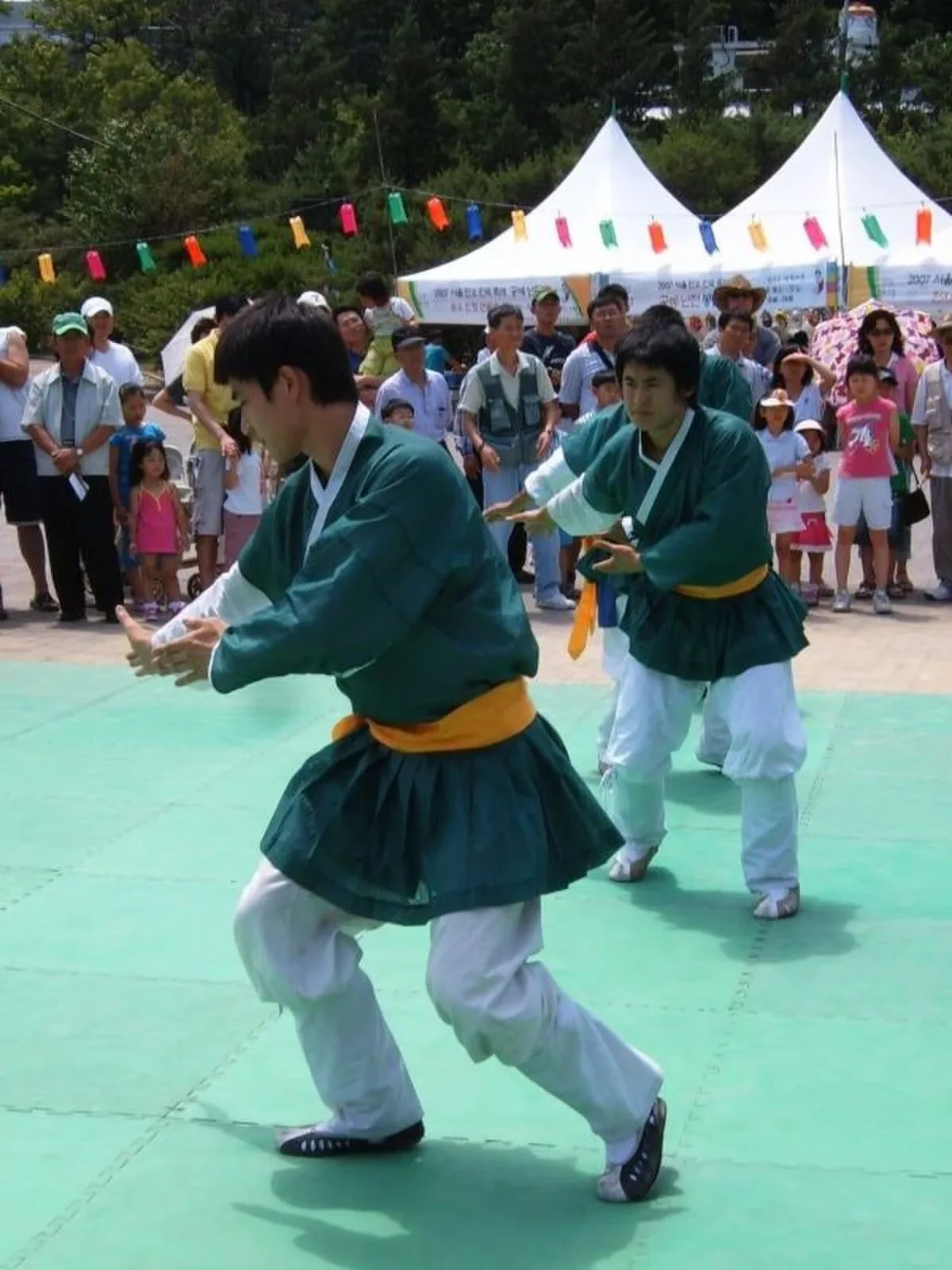 A taekkyeon performance photographed by ilovebdt and shared on Wikimedia Commons under CC BY 2.0. It illustrates a documented Korean martial-arts practice, not a fictional murim setting.
The characters 武林 combine the idea of martial practice with a forest metaphor. Robertson's Newcastle thesis explains that the forest is metaphorical: wulin refers specifically to martial-arts societies, not to a literal woodland. English translations vary between “martial forest,” “martial world,” and “community of martial artists.” The term is social. It suggests schools, lineages, rival associations, reputations, and rules that sit alongside ordinary government. It is not simply a synonym for magic cultivation.
Chinese wuxia uses related terms such as jianghu, literally “rivers and lakes,” for the wider social space in which wandering heroes, officials, merchants, and sects collide. In Korean, 강호 (ganghu) carries that jianghu reading, while 무림 (murim) points more specifically to the martial community. Newcastle's translation research explains why translators may render wulin as “martial world,” “pugilistic world,” or pinyin depending on the scene: the words overlap, but they do different jobs.
This is why a reader should not treat the literal “forest” as a fantasy forest. It is a social metaphor. A sect leader, an orthodox alliance, or a demonic cult can belong to the wulin even when the story contains no supernatural technique at all.
Is Murim Chinese or Korean? How Korea Made It a Genre
Korean readers encountered Chinese martial-arts fiction through translation, television, comics, and later digital serialization. Korean creators kept recognizable building blocks such as sect alliances, internal energy, sword schools, and a hidden martial society, then changed the rhythm and emotional emphasis. Modern murim fiction may prioritize a returner who remembers a ruined future, a medical specialist rebuilding a clan, or a comedic protagonist navigating sect politics. Those are Korean web-fiction habits layered onto an older vocabulary.
The result is not a counterfeit version of wuxia. It is closer to a living translation that became a local genre. Korean works can invent their own geography, food, honor codes, and historical references while still calling the setting murim. A Korean creator can also deliberately mix Chinese and Korean details, which is why a catalog label cannot substitute for reading the synopsis and opening chapters.
I find the distinction most useful when a reader asks why two stories with the same sect names feel different. The answer is often not that one author “got China wrong.” It is that Korean murim has a different serial toolkit: more explicit regression hooks, faster early power checks, and a strong interest in institutional reputation. Those tendencies are common, not universal laws.
Our What Is Murim? explainer maps the vocabulary readers meet once they begin a sect-based story.
For the practical reading differences between Korean murim and Chinese wuxia, use our separate comparison guide rather than treating this origin explainer as a genre scorecard.
What Murim Does Not Guarantee
The word does not guarantee accurate Korean history, accurate Chinese history, or a clean line between hero and villain. It does not guarantee that martial techniques stay human-scale. Some titles add qi explosions, reincarnation, game systems, or demonic transformations. Others remain grounded in alliance politics and swordsmanship.
It also does not guarantee that the romance, translation, or pacing will match another murim title. Community discussions on Reddit often use “murim” as a shorthand for a visual mood, while readers disagree about whether a Chinese cultivation novel belongs under the same label. That disagreement is evidence of a flexible market term, not proof that one side has a single official definition.
How to Choose a Murim Story Without Getting Lost
Read the first paragraph for the story's engine. If it names a destroyed sect and a returned master, expect reconstruction and strategic memory. If it opens with a wandering swordsman, expect more jianghu travel. If the synopsis promises a healer, chef, or merchant, the martial world may be a pressure system around a noncombat skill.
Then check the source platform and translation status. A title can be Korean in origin but available in English through a platform whose metadata uses a broad “Eastern” tag. That tag helps discovery, but it cannot settle the cultural question. Read the credited creator and the publisher's description before repeating a nationality claim.
For the genre next door, Wuxia vs Xianxia shows why martial-hero fiction and immortal cultivation are not interchangeable.
Frequently Asked Questions
Is murim Chinese or Korean?
Murim is the Korean reading of 武林, a Chinese term for the martial-arts community. Modern murim fiction is Korean in its contemporary genre practice, even when it uses Chinese-inspired worlds.
What does murim mean literally?
Murim is written 무림 in Korean and 武林 in Chinese characters. Wulin is commonly translated as martial forest or martial-arts world.
Is murim the same as wuxia?
No. Wuxia is Chinese martial-hero fiction, while murim is a Korean fiction tradition built from the wulin idea and Korean storytelling conventions.
Why do murim stories look Chinese?
Korean creators inherited terms, sect structures, and jianghu imagery through translated wuxia and martial-arts media, then adapted them for Korean comics and novels.
Does every murim novel take place in Korea?
No. Murim settings often use fictional names and a China-inspired martial world. The label identifies a Korean genre tradition, not a guarantee about the map.
What should I read after learning the murim origin?
Use a beginner explainer for vocabulary, then choose a Korean murim novel by tone: political sect drama, revenge, comedy, or an overpowered protagonist.
Related Reading
- What Is Murim?
- Best Murim Novels With an OP MC
- Wuxia vs Xianxia Difference
- What Is Xuanhuan?
- A Modern Man Transmigrated Into Murim: Where to Read
References
.jpg)

About the author

Danmei & Genre Critic
Danmei and xianxia critic with a background in comparative literature, writing about Chinese web fiction in English since 2019. Toronto-based.
- Writing about danmei and xianxia in English since 2019
- Graduate background in comparative literature
- Tracks the fan-translation-to-official-license pipeline
- Follows Seven Seas' convention announcements directly
Keep reading
3 Murim Novels With a Female MC: Official Webnovel Picks
Novels · 6 min
Double Agent of the Heavenly Demon Sect: Full Review
Novels · 5 min
Murim Novel With OP MC: Five Picks Worth Starting Today
Novels · 5 min
What Is Murim? Korean Martial Arts Fiction Explained
Novels · 5 min
Wuxia vs Xianxia Novels: What's the Real Difference?
Novels · 7 min
The Future of Wuxia: Translation Is the Next Fight
Genre Explainers · 7 min
Best Xianxia Novels With Romance Worth Reading in 2026
Novels · 5 min
The Best Wuxia Novels in English (2026): 3 Real Picks
Novels · 8 min
Disclaimer
This article is published for informational and entertainment purposes. It does not constitute professional financial, legal, or technical advice. Series availability, platform access, translation status, and chapter counts change. Verify critical details (pricing, regional availability, official translation status) with publishers and platforms. Affiliate links, where present, help support our editorial work and are labelled in our affiliate disclosure.
Comments
Loading comments…