Cultivation Novel Terms Glossary: Qi, Dao, Sects, and Realms
You don't need the whole vocabulary before chapter one. Learn what a sect, a realm and a spirit stone do, and the rest arrives in context.
Verdict: Learn sect, Qi Condensation and spirit stones first: the first three chapters of I Shall Seal the Heavens run on those and never mention a dantian or the Dao. Everything else can wait until a scene needs it.
These cultivation novel terms are a reader's map, not a universal rulebook. Wuxiaworld's general glossary supplies the definitions used here, while each author decides how far a word travels inside a particular story. Learn what a term does in a scene before assuming it has one fixed English equivalent.
To see the words at work rather than in a list, we read the first three chapters of I Shall Seal the Heavens on Wuxiaworld on October 15, 2026. The examples below come from those chapters. One surprise up front: in three chapters the translation never once says dantian, meridian or Dao. It runs on sects, Qi Condensation and spirit stones.
Cultivation Novel Terms: The Core Energy Vocabulary
Qi is the vital energy that exists in all things, in the Wuxiaworld glossary's words. Older translations write it Ki or Chi, and the English renderings run from "vital breath" to "spiritual energy". The natural supply around a character is often called the spiritual energy of Heaven and Earth. In I Shall Seal the Heavens, Meng Hao spends two months of evenings trying to sense it before a single strand of qi appears inside him. That's the scale a cultivation novel works at: one strand is a victory.
Qi circulation is moving that energy out of the dantian, through the meridians and back in a cycle. What it's for varies by novel; the glossary lists replenishing stamina, purifying qi and strengthening meridians. Meng Hao does it by sitting in meditation with his manual's "mnemonics and circulation technique", nudging the strand around his body until it reaches his whole frame.
Dantian literally means "Cinnabar Field" or "Elixir Field": the region of the body where qi is concentrated. Traditional practice has three, but these novels simplify and use only the lower one, about three finger widths below the navel. Think of it as the tank the rest of the system draws on.
Meridians are the channels qi flows through, like blood vessels for energy. Translations vary here: Meng Hao's manual tells him to "open the blood vessels and Qi passages", which is the same idea under another name. If a translation leaves the word in Chinese, the action around it usually tells you enough.
Spirit stones are translucent crystals with spiritual energy trapped inside. They're mainly currency among cultivators, and they also fuel cultivation, magic items and spell formations, so a pouch of them is both a wallet and a battery. The Reliance Sect hands them out to Outer Sect disciples every month along with medicinal pills, and Meng Hao is warned that taking them by force isn't against the rules.
Where qi and immortality sit in the genre's wider history, and what separates xianxia from Western magic.
What Is Xianxia? →
Cultivation Novel Terms: Dao, Realms, and Breakthroughs
Dao is the origin and source of all things, translated as the Way, Road, Path or Method. In these novels characters chase insights into the Dao because those insights can give them supernatural powers, even control over the natural world. When a character "comprehends" something, look for what they can do afterward.
Insight is how they get there. The glossary lists three routes: meditation, life-or-death battles, and going out into the world to experience new things. Insights are often what a cultivator needs to master a technique or move up a stage.
Realms are the stages of a power system. The common ladder looks like this:
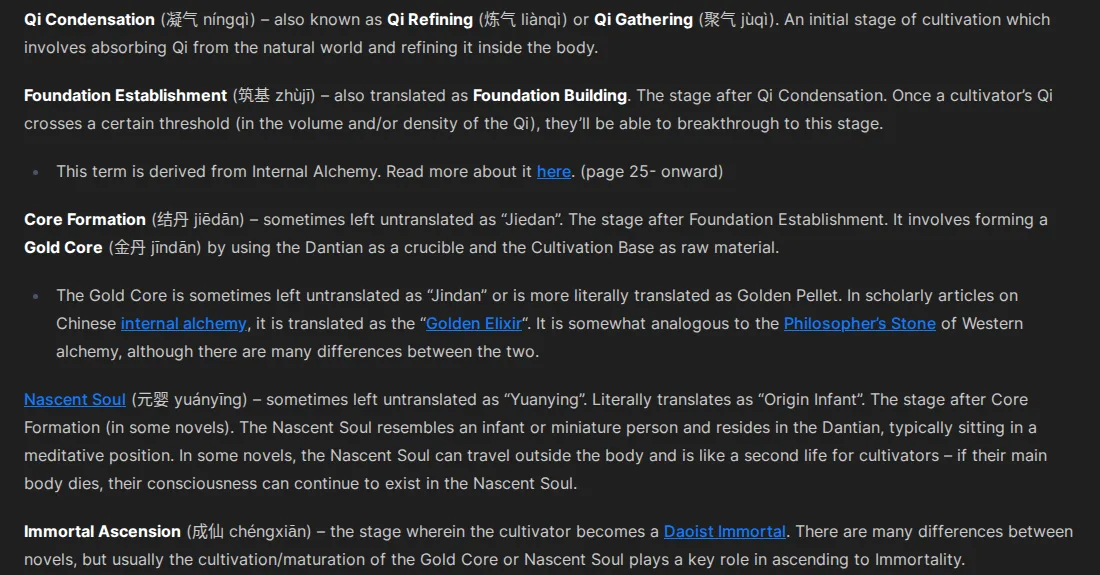 Screenshot: Wuxiaworld General Glossary of Terms, cultivation stages, October 15, 2026
| Stage | Also called | What it means |
|---|---|---|
| Qi Condensation (凝气) | Qi Refining, Qi Gathering | Absorbing qi from the natural world and refining it in the body |
| Foundation Establishment (筑基) | Foundation Building | Reached once the qi crosses a threshold of volume or density |
| Core Formation (结丹) | Jiedan, Gold Core | Forming a core, with the dantian as crucible |
| Nascent Soul (元婴) | Yuanying, "Origin Infant" | A miniature self in the dantian; in some novels it survives the body's death |
| Immortal Ascension (成仙) | Becoming a Daoist Immortal |
Wuxiaworld's introduction to xianxia traces this ladder to Xiao Qian's 飘邈之旅, which built a complete power system in 2005 that later writers borrowed and refined. Inside each stage, many novels count levels, often nine, or say early, middle, late stage and peak. I Shall Seal the Heavens shows why the numbers matter: reaching the first level of Qi Condensation gets a servant promoted to the Outer Sect, and Meng Hao takes four months to do it. The woman who kidnapped him is at the seventh level, which isn't enough to fly on her own; she needs a Wind Pennant because she hasn't reached Foundation Establishment.
Bottleneck is the wall a cultivator hits when progress suddenly gets very hard. Getting past it, the breakthrough, can take new insights, medicinal pills or harsher training.
Heavenly Tribulation appears in some novels: because cultivating toward immortality goes against the Will of Heaven, the Heavens push back, usually right as someone enters a new stage, typically with a lightning storm.
Qi deviation (走火入魔) literally means "to catch fire and be entered by devils". The cultivation base turns dangerously unstable, damaging the body and the mind. Practicing wrongly or losing to one's own internal demons, the negative emotions that block cultivation, can cause it.
Cultivation Novel Terms: Institutions and Tools
A sect is an organization devoted to cultivation or martial arts, usually led by a Sect Leader or Patriarch, with Elders teaching Disciples who live in the sect and are provided for by it. Some novels split disciples into Core, Inner and Outer ranks, and the higher you are, the more resources you get. The Reliance Sect in I Shall Seal the Heavens shows the other side: it's in decline, its Patriarch has been missing for nearly four hundred years, and it kidnaps servants because it can't recruit openly. Servants owe it thirty years of labor. When running the sect is the whole plot, that's its own subgenre; our sect building novels list starts with a founder who has a year to find four disciples.
The jianghu ("rivers and lakes") is the underground world of martial arts, everyone operating outside mainstream society. The wulin ("martial forest") is the community of martial artists within it. Both turn up more in wuxia; the cultivator's equivalent is the cultivation world.
Closed-door training is cultivating in seclusion, usually to break through a bottleneck or to avoid a backlash from being disturbed at a crucial moment.
Alchemy refines plants and minerals into medicinal pills and elixirs. A talisman is a strip of paper with diagrams and calligraphy, essentially a consumable spell. A jade slip is a strip of jade that stores information and transmits it straight into the reader's mind. Novels stretch these freely: in chapter 3, the jade slip Meng Hao receives glows green and floats ahead of him as a guide to the Treasure Pavilion.
Formations come in two kinds: battle formations of cultivators fighting together, and spell formations, also called arrays, that cast a continuous effect over an area, often switched on with formation flags. A Reddit reader, u/SkPSBYqFMS6ndRo9dRKM, put it neatly: "In most Xianxia, formation/array is the technique of arranging items or people in a specific way to influence the environment's energy flow."
Face is reputation. You can have it, give it (defer to someone), or lose it, and plenty of plot runs on it.
Martial vocabulary against cultivation vocabulary, for when a translation mixes both.
Wuxia vs. Xianxia →
How to Use This Glossary While Reading
Wuxiaworld already does part of the job: its reader underlines names and terms in the chapter, and you can click one to look it up. The "Explain" button that gives definitions in context asks you to log in first.
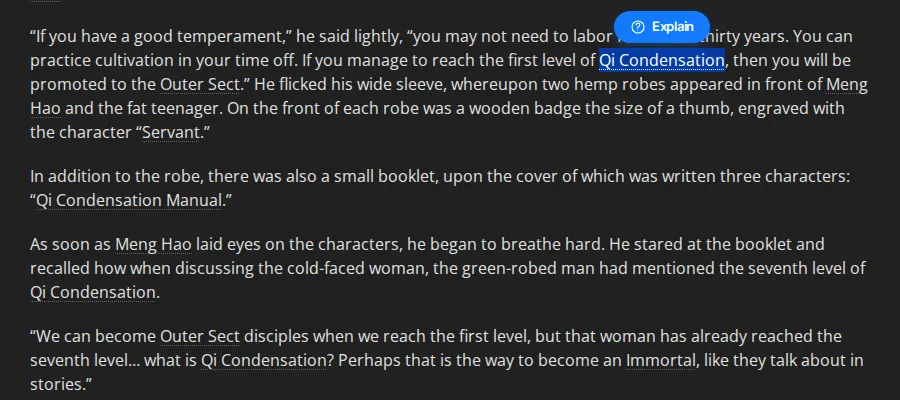 Screenshot: Wuxiaworld, I Shall Seal the Heavens chapter 2, with a term selected, October 15, 2026
Realm rules are where readers get stuck, because every book bends the common ladder. This thread is a typical example: a reader asking why a formation-based novel's hero went back to fourteen lines after Foundation Establishment.
Readers don't agree on how much should stay in Chinese, either. u/YoungYorghut wants realms in English: "Nobody wants to bother with flipping to the glossary section every time they pick up a novel." u/setecordas disagrees: "I prefer keeping terms and honorifics untranslated. A glossary is fine, but I iust don't think a translator should be dumbing anything down for a lazy audience." We're with the first camp for realms and with the second for words like dantian, which lose more than they gain in English.
What These Terms Do Not Guarantee
Knowing the glossary won't tell you whether a translation is official, whether a sect is the good guys, or whether a given realm exists in a given book. It also can't turn every spiritual idea into a neat Western fantasy match: the glossary itself calls the Gold Core only "somewhat analogous" to the Philosopher's Stone of Western alchemy.
Our advice: learn the six or seven words a first chapter uses, and look the rest up when a scene stalls. For the genre labels around all this, What Is Xuanhuan? and What Is Murim? cover the neighbors.
How We Checked This
Definitions come from Wuxiaworld's General Glossary of Terms and its introduction to xianxia, read on October 15, 2026; the examples from chapters 1-3 of I Shall Seal the Heavens on Wuxiaworld the same day, nothing further. The reader comments come from two r/noveltranslations threads.
Related Reading
- What Is Xianxia?
- I Shall Seal the Heavens Review
- Wuxia vs. Xianxia
- What Is Xuanhuan?
- What Is Murim?
- Xianxia Tropes Explained
- What Is Danmei?
References
About the author

Danmei & Genre Explainers Desk
Pen name for NovelBrief's danmei and genre desk: xianxia and xuanhuan conventions, danmei licensing, what a print edition changes.
- Covers danmei, xianxia and xuanhuan, plus genre explainers
- Separates publisher-confirmed facts from fan speculation
- Flags content ratings when the source states them
Keep reading
Best Xianxia Novels With Female Lead Worth Starting
Novels · 8 min
Best Completed Xianxia Novels in 2026: Six Long Reads
Novels · 8 min
Best Xuanhuan Novels in English (2026): Eight Picks
Novels · 9 min
Xianxia Tropes Explained: Sects, Cautious Heroes and Alchemy
Novels · 9 min
Best Xianxia Novels in 2026: Six Official English Picks
Novels · 9 min
A Will Eternal Reading Guide: Start Bai Xiaochun's Journey
Guides · 7 min
How Long Is Reverend Insanity? Volumes and Where to Start
Guides · 8 min
Xianxia vs Xuanhuan Difference: A Practical Reader Guide
Novels · 8 min
Disclaimer
This article is published for informational and entertainment purposes. It does not constitute professional financial, legal, or technical advice. Series availability, platform access, translation status, and chapter counts change. Verify critical details (pricing, regional availability, official translation status) with publishers and platforms. Affiliate links, where present, help support our editorial work and are labelled in our affiliate disclosure.