Loading…

NovelBrief · Guides
The Monk That Wanted To Renounce Asceticism Reading Guide
Use this The Monk That Wanted To Renounce Asceticism reading guide to start at chapter 1, track 1,512 chapters, and handle the 1,515-chapter original.
11 min readBy Mei-Lin Zhao
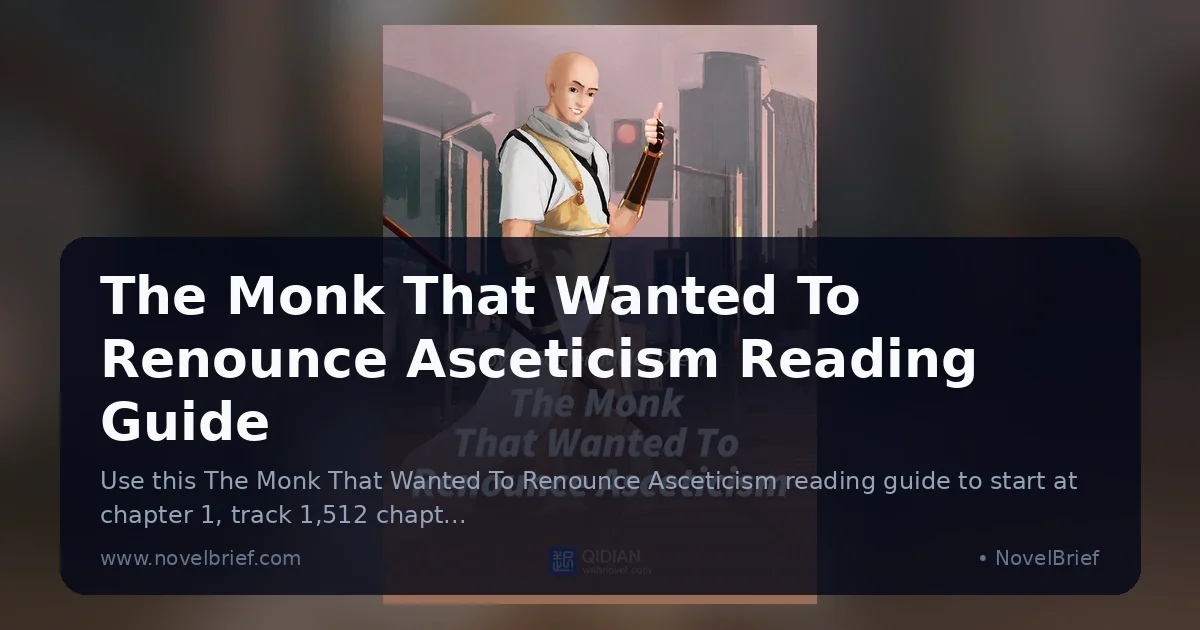
This The Monk That Wanted To Renounce Asceticism reading guide is for readers who want a clean way into a very long, completed comedy. The published review identifies Yimeng Huangliang as the author, Fangzheng as the reluctant abbot at the center, and Webnovel's English catalog as complete at 1,512 chapters with CKtalon credited from the beginning. The original Chinese serial is recorded at 1,515 chapters, so edition awareness matters from the first bookmark.
TL;DR: Start The Monk That Wanted To Renounce Asceticism at chapter 1 on Webnovel and follow the numbered English catalog through 1,512 completed chapters. Keep the 1,515-chapter Chinese count as a source-language note, not a reason to jump or search for a missing English volume.
Key Takeaways
- Start at chapter 1; there is no required prequel or adaptation handoff in the source review.
- Webnovel's English catalog lists 1,512 completed chapters, while the original Chinese serial is recorded at 1,515.
- CKtalon is credited as translator and editor for the English run, giving the long catalog one consistent reference point.
- Read the Buddha System tasks, temple maintenance, and comedy as part of the progression rather than disposable side material.
- Use chapter number, title, and edition together whenever you stop and return.
The Monk That Wanted To Renounce Asceticism Reading Guide: What It Covers
This guide answers how to start, pace, and resume the completed Webnovel edition. It does not repeat the review's 8.0/10 verdict, because a reading guide has a different job. You need a stable route through the catalog, a way to interpret the two chapter counts, and a checkpoint habit that does not turn every comedy arc into a skip list.
The story's opening problem is concrete. Fangzheng is an abbot who wants to leave a crumbling temple, eat meat, and get married, but a Buddha System ties his choices to the temple and its visitors. That premise creates a sequence of small obligations before the story grows. Starting in the middle would remove the reason those tasks matter, so chapter 1 is the correct entry point even if a recommendation highlights a later face-slapping scene.
The count difference is not a puzzle you need to solve before reading. The review source records the original Chinese serial, 老衲要还俗, as running from March 2017 to January 2019 with 1,515 chapters. It records the official English catalog at 1,512 chapters and marks it completed. When a source-language total and an English catalog total differ, your edition's numbering is the useful navigation system.
 A clean crop of the real Webnovel cover from the review source marks the start of this guide.
Step-by-Step
1. Open the official catalog: Use the Webnovel listing for The Monk That Wanted To Renounce Asceticism to confirm the title, author credit, completed label, and current chapter presentation. Record the edition name before you begin.
2. Start at chapter 1: Read the opening temple problem before deciding whether the system comedy suits you. Fangzheng's reluctance, the failing temple, and the Buddha System are the operating conditions for later tasks. A scene encountered through a clip or recap cannot supply that context in the same order.
3. Follow the English numbers in sequence: Treat the 1,512 Webnovel chapters as the path for the edition you are reading. Do not insert three extra entries because a Chinese index says 1,515, and do not assume a missing number means you need a new series page. Check the catalog title and the previous chapter when something looks unusual.
4. Mark system tasks and temple changes: In a private note, record a task only when it changes Fangzheng's options, the temple's standing, or a recurring relationship. This keeps the guide useful without turning a comedy serial into a spreadsheet of every item the Buddha System displays.
5. Keep a translation checkpoint: Save the chapter number, chapter title, and the date you checked the catalog. The review source credits CKtalon as translator and editor across the English run. If a page presents a different author name, translator, or chapter total, pause and verify the edition before continuing.
6. Finish the numbered English catalog: When you reach chapter 1,512, use the Webnovel completion label as the endpoint for this English route. Keep the 1,515 figure in your notes as the original-language count, not as an instruction to search for a hidden continuation.
Why the Original and English Counts Differ
A three-chapter difference does not automatically mean the English edition is incomplete. Serial platforms can split, merge, or package entries differently, and the source review explicitly records both numbers rather than forcing them into one total. The safest statement is therefore edition-specific: the original Chinese serial is listed at 1,515, while Webnovel's English catalog is listed at 1,512 and marked completed.
This distinction is useful beyond this one book. A reader who searches “chapter 1,515” while reading an English catalog may land on an unrelated repost or a machine-translated index. A reader who treats “completed” as a universal count may think the publisher has lost material. Save the page identity and the chapter title you last read before you investigate a mismatch.
The review source also identifies the Qidian publication window, March 2017 to January 2019. That gives you a verified original-serial context without requiring a second reading order. The guide does not invent an English volume split, because the official catalog's numbered chapters are the useful path.
If you're unsure whether a reading platform is legitimate before committing to a 1,512-chapter run, covers account, payment, and content safety checks.
Is Webnovel App Safe? What New Readers Should Know
The Monk That Wanted To Renounce Asceticism Reading Guide: Buddha System Notes
The Buddha System is a navigation clue, not a reason to skip. Its tasks connect Fangzheng's personal wishes to the temple's daily needs, so a seemingly small request can introduce a visitor, practice, or relationship that matters later. The comedy is often the delivery mechanism for setting information. A guide that tells you to skip every episodic task would remove the structure that makes the long run coherent.
Use a simple three-part note when a task begins: what Fangzheng wants, what the system asks, and what the temple or visitor risks. You do not need to record rewards unless they change a later choice. This keeps the reading active while leaving room for the story's reflective moments about temple life, Buddhist practice, and modern rural-to-urban China.
The system format also makes the book easy to sample. Read the opening chapters in full, then ask whether the mix of faceslapping comedy, small-community problem solving, and sincere reflection is something you want for 1,512 chapters. If the answer is no, you have tested the actual book rather than a description that only mentions the monk gimmick.
Pacing a Completed 1,512-Chapter Comedy
Set checkpoints at a size that preserves the joke and the local problem. Fifty chapters is a reasonable interval for a light session; one hundred can work when you have time to remember the recurring residents and temple changes. At every checkpoint, record the chapter title and one sentence about the temple's current situation. That is more helpful than saving a list of system rewards.
Do not let the original 1,515 count pressure you into reading past your edition's endpoint. Finish the catalog you started, then decide whether you want to compare the source-language index as a separate research task. Mixing counts mid-read is how a clear completion label turns into a false missing-chapter panic.
If you need a break, reread the last scene rather than a later synopsis. The series' episodic shape makes it tempting to ask what “important” arc comes next, but that question often produces spoilers. Let the current visitor, task, or temple problem be the reason you continue.
 Use the chapter title and the current temple problem as a private return marker.
The Monk That Wanted To Renounce Asceticism Reading Guide: Spoiler-Safe Tips
- Read the first chapter before searching for the Buddha System's full mechanics.
- Keep the English and original chapter counts in separate notes.
- Search the exact chapter title before searching Fangzheng's name.
- Treat a task list as a memory aid, not a reason to skip an entire run of chapters.
- Check translator and author credits if a page presents a different total.
- Use a calendar checkpoint when a long comedy's episodic rhythm makes your browser history unhelpful.
The safest reference is the smallest reference that solves the problem in front of you. If you forget a temple name, look up that name after recording your current chapter. If you forget why a task exists, reread its opening. A large spoiler guide can answer both questions while also revealing where the comedy's relationships eventually go.
For the base cultivation vocabulary this novel's Buddha System riffs on, without assuming its rules are universal, read .
What Is Xianxia?
When to Continue or Stop
Continue when the contrast between Fangzheng's reluctant plans and the temple's real needs makes you curious about the next visitor. Stop when the episodic system rhythm feels like repetition rather than texture. The completed status means you can make that decision without worrying about a future hiatus, but it cannot make the tone fit every reader.
This is also why the guide does not promise that every chapter carries the same kind of plot weight. The review source praises the comedy and reflection while noting that the system creates self-contained arcs. Read those arcs as the book's chosen shape. A reading order is not a ranking of which chapters deserve to exist.
Frequently Asked Questions
Where should I start The Monk That Wanted To Renounce Asceticism?
Start at chapter 1 on the official Webnovel catalog and continue in its numbered order. The English catalog lists 1,512 completed chapters.
Why do some sources say 1,515 chapters?
The review source records 1,515 chapters for the original Chinese Qidian serial and 1,512 chapters in Webnovel's English catalog. Use the count and numbering of the edition you are actually reading.
Is the English translation complete?
The review source says Webnovel marks the English catalog completed at 1,512 chapters and credits CKtalon as translator and editor.
Should I skip the comedy or system chapters?
No. The temple problems, Buddha System tasks, and comedic detours establish Fangzheng's progression and the setting's recurring relationships.
Do I need to read a cultivation novel before this one?
No. The story explains its own system and modern setting. A general cultivation glossary can help, but no companion title is required.
Related Reading
- The Monk That Wanted To Renounce Asceticism Review
- What Is Xianxia?
- Best Xianxia Novels With a System
- Is Webnovel App Safe?
- Warlock of the Magus World Reading Guide
References
Was this guide helpful?
About the author

Danmei & Genre Critic
Danmei and xianxia critic with a background in comparative literature, writing about Chinese web fiction in English since 2019. Toronto-based.
- Writing about danmei and xianxia in English since 2019
- Graduate background in comparative literature
- Tracks the fan-translation-to-official-license pipeline
- Follows Seven Seas' convention announcements directly


Disclaimer
This article is published for informational and entertainment purposes. It does not constitute professional financial, legal, or technical advice. Series availability, platform access, translation status, and chapter counts change. Verify critical details (pricing, regional availability, official translation status) with publishers and platforms. Affiliate links, where present, help support our editorial work and are labelled in our affiliate disclosure.
Comments
Loading comments…